Across primary education, there is a growing focus on foundational mathematical skills, and with good reason. As conversations around curriculum design, attainment and closing gaps continue, increasing attention is being given to what happens with children’s earliest mathematical experiences and the consequent impact these have on long-term success. As a Primary Maths Teaching and Learning Adviser, I see how secure foundations in number sense, counting, subitising and mathematical talk support children's success throughout their school journey. This renewed emphasis is not about moving children on more quickly or memorising sets of facts by rote, but about developing deep, lasting understanding from the very beginning. In this blog, I explore why foundational maths matters, what effective practice looks like, (particularly with one area of formal written calculation), and how investing in these early experiences helps children become confident and successful mathematicians.
Many of us would agree that some of the difficulties pupils experience with formal written calculation in Key Stage 2 originate much earlier in their mathematical development. While errors in column addition and subtraction may appear to stem from misunderstanding written methods, they are often linked to insecure understanding of number relationships, number composition and place value—concepts that begin developing in the Early Years and continue to be strengthened throughout Key Stage 1.
Mathematical fluency develops from recognising small quantities and understanding number composition to calculating with large whole numbers and decimals. Although numbers become larger and methods more sophisticated, the underlying mathematical structures remain consistent.
The foundations of number sense: From subitising to part-part-whole thinking
One of the earliest and most important mathematical skills children develop is subitising – the ability to recognise a quantity without counting each item individually. While it may seem like a simple skill, subitising plays a crucial role in developing number sense and lays the groundwork for later calculation strategies.
Children first develop perceptual subitising, where they instantly recognise small quantities, usually up to about five depending on the layout, without counting. For example, they can quickly identify:

This immediate recognition helps children move beyond counting as their only way of understanding number.
As their mathematical understanding grows, children begin to develop conceptual subitising. At this stage, they no longer see numbers simply as collections of individual objects; instead, they recognise them as groups made up of smaller parts. For example, a child might see a group of five as a three and two, or even be able to subitise seven, as a group of four and a group of three.
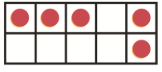
The counters on this tens frame might be recognised as a group of 3 and 2, making the 5.
This is where the connection to part-part-whole models becomes particularly significant. Conceptual subitising helps children understand that numbers can be composed and decomposed in different ways:
- 5 = 3 + 2
- 7 = 4 + 3
Part-part-whole models provide a powerful visual representation of these relationships. They help children see that a number (the whole) can be split into smaller parts and that those parts can be recombined to create the whole again. Rather than memorising facts in isolation, children develop a deep understanding of how numbers are structured.
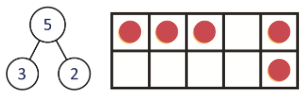
For example, when children explore the number 5 using a part-part-whole model, they begin to recognise multiple combinations such as 3 and 2, 4 and 1, or 5 and 0. This flexibility develops confidence in working with number relationships, and supports the development of efficient mental calculation skills later in the learning journey.
Through repeated experiences with subitising and part-part-whole representations, children begin to recognise important mathematical structures. They learn that numbers are connected and can be manipulated, partitioned and recombined in meaningful ways. These understandings underpin key concepts such as:
- number bonds
- doubles and near doubles
- addition and subtraction relationships
- mental calculation strategies
- early algebraic thinking.
Children who develop a strong understanding of number relationships are more likely to use efficient calculation strategies as they progress through school. In contrast, children who rely solely on counting often find mathematical tasks increasingly challenging as numbers and calculations become more complex.
Although these early experiences may appear far removed from formal written methods, they are in fact the foundations upon which all later mathematics is built. By nurturing subitising and using part-part-whole models to explore number composition, we help children develop the deep, connected understanding of number that supports success throughout their mathematical journey.
By the end of Reception, for example, children are expected to recall number bonds up to 5 (including subtraction facts) and some number bonds to 10, as part of the Early Learning Goal for Number.
The significance of the ‘terrible teens’
The numbers 11–19, often referred to as the ‘Terrible Teens’, can present a surprisingly complex challenge for young learners. Although they are introduced relatively early in children's mathematical development, teen numbers are often more difficult to understand than some other two-digit numbers because they do not appear to clearly follow the word patterns children later see in number-naming such as twenty-one or thirty-four. Nevertheless, mastering teen numbers marks an important milestone in developing number sense and provides a crucial foundation for later understanding of place value.
For many children, teen numbers represent their first meaningful encounter with the base-ten structure of our number system. However, the English language can obscure this structure.
Number names such as eleven, twelve or fifteen give few clues about how the numbers are composed, making it harder for children to recognise that each teen number consists of one group of ten and some additional ones. Interestingly, this contrasts sharply with languages such as Chinese, Japanese and Korean, where number words more transparently reflect their mathematical structure. For example, 15 is expressed as “ten-five” and 17 as “ten-seven”, making the relationship between tens and ones immediately apparent.
Because English-speaking children do not benefit from this linguistic support, they often need rich practical experiences to build a secure understanding of teen numbers. Representations such as ten frames, Rekenreks and place value resources help children visualise the composition of these numbers and connect spoken number names with their underlying mathematical structure.
At their heart, teen numbers follow a simple and consistent pattern: 11 is one ten and one one, 14 is one ten and four ones and 17 is one ten and seven ones. Some might say that their written numerals maybe more helpful with this understanding than their spoken names.
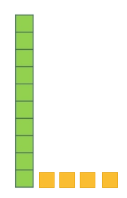
When children learn to see teen numbers in this way, as a ten and some ones, they begin to develop an understanding of unitising and place value, laying the groundwork for future learning in number and arithmetic. Whilst the composition of each teen number is not referenced explicitly within the Early Learning Goals, it does state that children at the end of the EYFS (Reception year) should be able to verbally count beyond 20, recognising the pattern of the counting system. This counting secures children's first experience with the 'language' of saying the teen numbers in order.
In key stage 1 a key milestone is fluency with numbers to twenty (including their composition). This builds confidence, develops number sense, supports reasoning and problem-solving, and provides the secure foundations needed for future mathematics learning. The current National Curriculum (2014) for Mathematics identifies fluency as one of the three core aims of mathematics because it enables children to recall and apply knowledge rapidly, accurately and with understanding.
A secure understanding of the composition of teen numbers (as ten and some more) can also bridge early counting experiences and later work with place value.
When pupils recognise that 17 = 10 + 7 they are also developing the basis of the understanding needed to see that 117 = 100 + 10 + 7 and later 1,117 = 1,000 + 100 + 10 + 7.
Although the numbers become larger, the structure remains the same.
The crucial significance of fluency with teen numbers in formal calculations
Difficulties with teen numbers do not always disappear once children move beyond early number work. Insecure understanding of numbers within 20 (and their composition), frequently reappear when pupils encounter formal written calculation methods.
For example, when calculating 85 + 68:
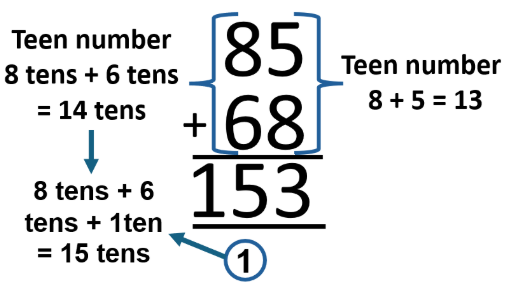
The first calculation in the ones column of 85 + 68 is the 8 + 5. The children need to calculate this to reach the teen number (13), and then recognise that the thirteen ones can be regrouped as ten and three ones. The ten can then be included below the tens column to be added in later, and the remaining three placed in the ones column. The second calculation of 8 tens + 6 tens is then carried out as another calculation which results in a teen number;14 tens, plus the 1 more ten (gained from the original 13). We need the children to recognise that the result is fifteen tens, which is one hundred and fifty and therefore the one digit is placed in the hundreds column. As children make progress through three-digit, four-digit and numbers, and eventually beyond one million, the process is exactly the same with the digits needing to be explicitly linked to their place value and the powers of ten.
Subtraction creates similar challenges with deep understanding of teen numbers also being prevalent.
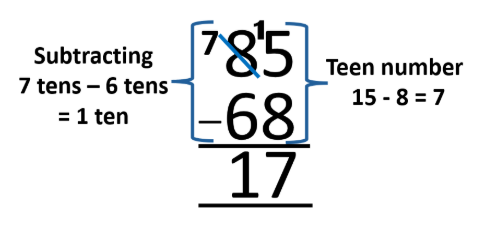
Decimals then build on the same place value understanding that children have developed with whole numbers. Rather than being a new concept, decimals extend the place value system to the right of the decimal point, with tenths, hundredths and thousandths.
For example, in 4.44, the first 4 represents four ones, the 0.4 represents four tenths, and the 0.04 represents four hundredths. When adding decimals such as 3.7 + 2.8, children combine the tenths with 7 tenths + 8 tenths = 15 tenths (again, based on a teen number calculation), and then regroup the 15 tenths as 1 whole and 5 tenths, giving 1.5.
The final answer to 3.7 + 2.8 is 6.5, once the 3 ones and 2 ones have been added as well.
This example of the 7 tenths + 8 tenths = 15 tenths, giving 1.5, mirrors the process of exchanging ten ones for one ten in whole-number calculations; the structure of place value and the base-ten nature of our number system remains in place.
Without this understanding, regrouping and exchanging becomes a procedure to memorise rather than a process that pupils genuinely understand.
The impact on accuracy and efficiency
Many errors in written calculation are likely to stem not from misunderstanding the method itself, but from weak fluency with basic number facts and number relationships.
If addition and subtraction facts within 20 are not secure, the demands of the calculation can become overwhelming, leading to:
- forgotten exchanges
- incorrect regrouping
- misplaced digits
- incomplete calculations.
Fluency also affects efficiency, for example a pupil who is less fluent in their fact recall within 20 may repeatedly count, recalculate known facts or struggle to remember exchanged values. Even when the final answer is correct, the process is slower and requires significantly more mental effort.
Working memory and cognitive load
The relationship between number fluency and formal calculation can be understood through cognitive load.
Formal written methods require pupils to manage:
- place value understanding
- number facts
- accurate recording
- the sequence of the algorithm.
If number facts are not secure, working memory becomes occupied by calculations that should ideally be automatic.
Secure number relationships free up working memory to focus on the calculation structure; insecure relationships increase cognitive load and the likelihood of errors. Recognising these structures helps pupils transfer understanding across different contexts and magnitudes.
Implications for teaching
The importance of number sense extends well beyond the Early Years and key stage 1.
Teachers are likely to want to provide regular opportunities for pupils to:
- explore number composition and decomposition
- revisit part-whole relationships
- strengthen number bonds and arithmetic facts
- deepen place value understanding
- use precise mathematical language
- make connections across mathematics.
Pupils are likely to benefit from age-appropriate opportunities to notice patterns such as:
- 8 + 7 = 15
- 38 + 7 = 45
- 138 + 7 = 145
Such connections promote flexibility, efficiency and confidence.
Foundational learning and the development of secure number sense
The progression from subitising to calculations involving millions and decimals is far more connected than it may first appear. Throughout primary mathematics, the same fundamental ideas recur time and again: number composition, place value, regrouping and exchange.
The “terrible teens” are far more than a key stage 1 milestone. They provide children's first meaningful encounter with the base-ten structure that underpins all later mathematics.
When pupils struggle with formal calculation, it could be that revisiting these foundational concepts is more effective and beneficial than additional practice of procedures alone. Mathematical success depends not simply on learning algorithms, but on developing a secure and connected understanding of number that grows over many years. A strong understanding of teen numbers, for example, can lay the foundations for formal calculation. When children recognise the construct of teen numbers, they are more equipped to use efficient calculation strategies with confidence and accuracy.
The journey across the primary school years, to calculating confidently to a million begins with some seemingly simple moments: a child looking at a small pattern of dots and instantly recognising that there are five, or knowing how to approach adding numbers such as 7 + 6.
Doug Harmer