Belonging in maths
Let me begin with a confession many adults quietly carry. As a child, maths lessons never felt like a place I belonged. It seemed fast, fixed and, if I’m honest slightly terrifying. You either ‘got it’ or you didn’t. I decided early on that I didn’t, and I’m far from alone; plenty of adults still shrug and say, “I’m just not a maths person.”
But here’s the thing; no one is born thinking that. That belief is learned and passed on by adults who do not understand how children learn, and this is exactly why the early years of life matter so profoundly for our young mathematicians. Early childhood is a time of astonishing brain growth, when experiences shape the pathways that support reasoning, problem‑solving and confidence. When children encounter maths in playful, meaningful ways, they build the strong foundations that shape how they see themselves as learners for years to come.
Breaking the ‘who is good at maths?’ myth
We need to gently (or not-so-gently) retire the old idea that some children, often boys, are simply maths people. Mathematical development isn’t just about talent, it’s about opportunity, exposure, and the quality of adult interactions. When adults sequence learning effectively, revisit regularly, have high expectations for all children and offer rich experiences, children begin to see themselves as mathematicians and that shift is everything! Research shows that ‘teaching methods, curriculum design, and opportunities for problem‑solving have a measurable impact on children’s maths development. Supportive environments reduce anxiety and increase engagement’.
Biologyinsights.com: Is math ability genetic or learned from the environment?
In the Early Years, maths hides in plain sight
Putting on coats becomes an opportunity for sequencing; register and snack time become moments for counting and comparing; tidy-up time becomes sorting and classifying. Through these ordinary routines, children develop mathematical language, conceptual understanding, and the confidence to apply ideas in context. Words like more than, fewer than, the same as, altogether, longest, and shorter become tools for thinking. These small, everyday moments quietly build the foundations children will rely on later.
Playing and exploring, mathematics becomes deeply physical
Children build, stack, balance, compare, tip, pour, and test. A cylinder rolls freely on its curved surface; a sphere dances away with no edges or corners to slow it. A cone wobbles in widening circles, a pyramid stands firm on its broad base, and a triangular prism refuses to roll or stack the way children expect.
With an adult’s gentle narration and open questions offered at just the right moment, children begin to notice straight and curved sides, flat and curved faces, edges, and corners. In these small encounters, they start to feel the logic of shape. With every tumble, roll, and wobble, their mathematical thinking and reasoning grow.
Small world play is a treasure trove of spatial understanding
Children naturally use language like over, under, through, next to, behind, in front, inside, outside and between. Alongside the adults, they narrate their play: “The train goes through the tunnel,” or “It’s under the bridge.” This is mathematics that feels alive because it grows from play.
Let’s not forget song and rhyme!
Whether it’s counting down little ducks or frogs, or counting up the hickory dickory clock, there are so many opportunities for mathematics within song, rhyme and reading. Find ways to incorporate rhymes and songs into your daily routines and audit your book stock to ensure there are many relevant books to ‘bump into’ within your learning environment.
Adult action that builds mathematicians
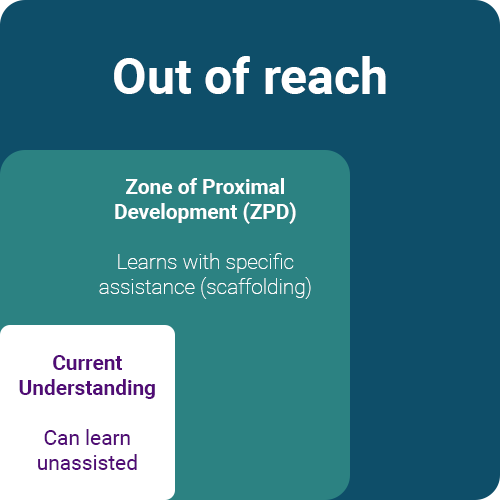
High-quality early years mathematics comes from thoughtful environments, responsive interactions, and a clear understanding of how young children learn. The early years lay the groundwork for reasoning, pattern‑spotting, and problem‑solving, and adults play a crucial role in shaping these foundations. Children learn best when they feel safe, curious, and confident. When adults celebrate effort and value mistakes, children develop resilience and see themselves as capable mathematicians. Strong foundations don’t come from worksheets or speed. They come from rich experiences, responsive adults and environments that invite thinking. Teaching lives in the moment: skilled adults watch, listen, and step in with just the right prompts. They narrate and model mathematical language naturally, notice misconceptions early and think aloud to show how mathematicians’ reason. This is Vygotsky’s Zone of Proximal Development in action.
The environment matters
Warm, inviting spaces, baskets of objects to sort, tall trees waiting to be measured, loose parts ready to be arranged into patterns, and numerals paired with meaningful objects become a living curriculum that children can step into. When adults observe closely and rotate resources with purpose, children’s mathematical thinking doesn’t just grow; it expands in new directions. With varied textures to feel, scales to compare, quantities to explore, and numerals displayed in thoughtful ways, the environment becomes a silent teacher. It gently prompts children to estimate the weight of a stone, classify leaves by size, measure the length of a branch, count treasures they’ve collected, match symbols to quantities, and solve problems through rich, self-directed exploration.
Mathematics beyond the classroom
Maths comes alive outdoors. It becomes big, bold, and embodied. Children count their hops, jumps and skips, count steps and marvel at how far their feet can take them. They compare the worms they find in the digging area. “My worm is long,” “Mine is the longest!” Their eyes widening with wonder at the tiny creatures wriggling in their hands. They look closely to discover which flower is the shortest, noticing details they hadn’t seen before and count the petals. In the sand pit, they explore full and empty, heavy, and light, captivated by how the sand shifts and pours. They measure puddles with sticks, amazed at how deep they are, and discover which bucket holds more water. This is mathematics that is experienced, not delivered but rooted in awe, wonder, curiosity, and the joy of finding out.
Progression is intentional. Number sense develops in layers, matching, sorting, comparing, recognising small quantities, and understanding that the last number counted tells us how many. Adults who understand this know when to pause, revisit or move forward.
Context gives maths meaning. Sharing fruit becomes fairness, the first whisper of division. Building rises into height; weighing settles into balance and pouring unfolds as capacity. In these everyday moments, the curriculum lives, revealed when adults, with gentle sensitivity, name the learning as it happens.
What we build in the early years. Not just children who can count, but children who notice patterns, reason, compare, classify, and explain their thinking with confidence. This is where our mini mathematicians emerge. Children who count snack portions without thinking, who tally blocks as towers rise, who count steps to a puddle before measuring its depth with a stick.
Children who don’t fear maths because, for them, it’s simply how the world works, it’s a language they already speak.