While the term 'Foundational Knowledge' has gained significant prominence in recent Ofsted subject reports and the Strong Foundations (2024) evaluation, it represents a timeless pedagogical truth: securing automaticity in the foundational prerequisites allows a child’s brain the space needed to think about complex and/or more abstract concepts. The success of a primary curriculum is rarely determined by the complexity of what is taught, for example in Year 6, but by the security of what was mastered in the years prior. I believe the message is clear; learning is not just a series of experiences, but a carefully sequenced and constructed journey.
It may help to view the primary curriculum as a building. The ambitious, sophisticated work we see at the end of Key Stage 2 (the building embellishments) is entirely dependent on the depth and strength of the foundations laid down in the early years. If the foundational building blocks in EYFS and KS1 are shaky or even missing entirely, the building will struggle to support the weight of complex concepts and analytical thinking.
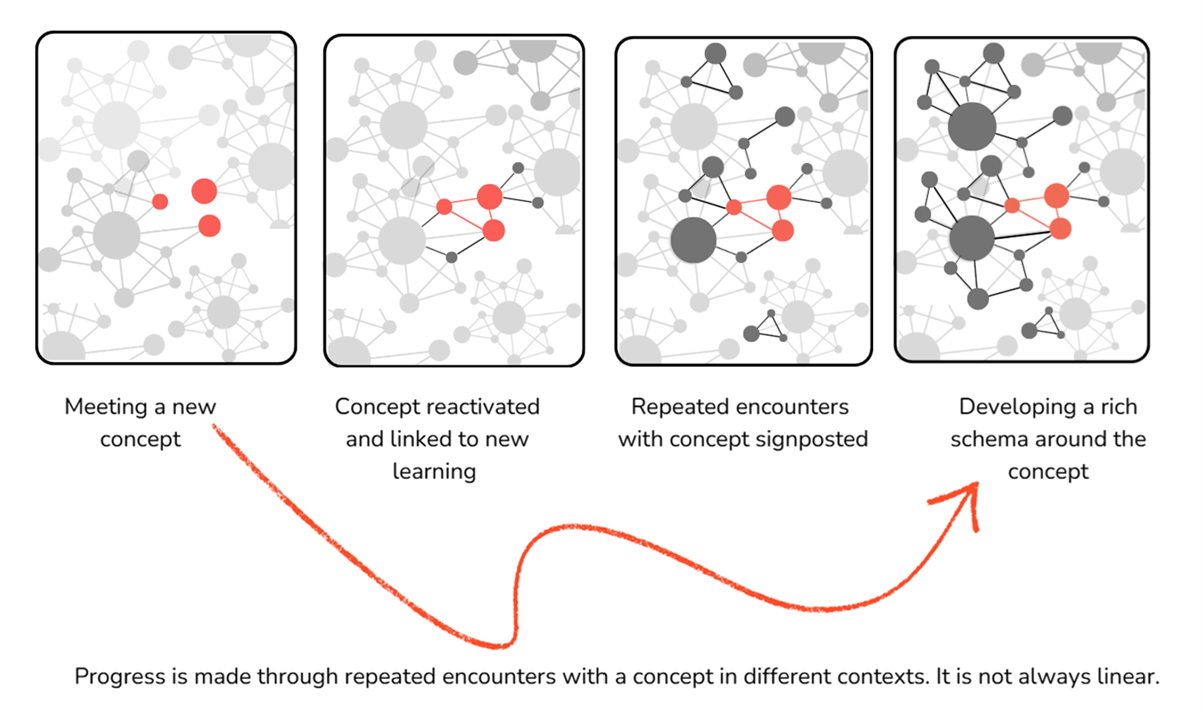
This analogy helps explain a curriculum but also the results of a well-planned and carefully sequenced curriculum that prioritises foundational learning: a child’s resultant schema. If the foundational concepts of a curriculum are secure, new knowledge can form connections to this secure, stable base and rich schema are developed. Knowledge is ‘sticky’ and connected. When a child’s bedrock foundational knowledge (like their handwriting or phonic knowledge) is shaky, their brain is working so hard on the mechanics that there is no room left for the message.
The truth is simple: we need to prioritise and secure the basics, particularly in EYFS and KS1. By making the foundations automatic, we give children the mental space to reach for expertise as children progress in their learning.
What is Foundational Knowledge?
Before we can audit our curricula to ensure that we have identified and sequenced foundational knowledge in a subject, we must be clear on our definitions. Foundational knowledge refers to the core building blocks—the fundamental information and skills that we intend pupils to develop initially in EYFS and KS1. Where these foundational building blocks are not secured, we know that work needs to continue to embed.
The diagram below shows the basis of all children’s learning – the three prime areas. Learning begins here as these areas contain the prerequisites needed for all future successful learning. Foundational learning in reading, writing, communication, number and executive function develop from these prime areas. The third pink layer refers to the threshold concepts for each subject. All future learning in a subject stems from here.
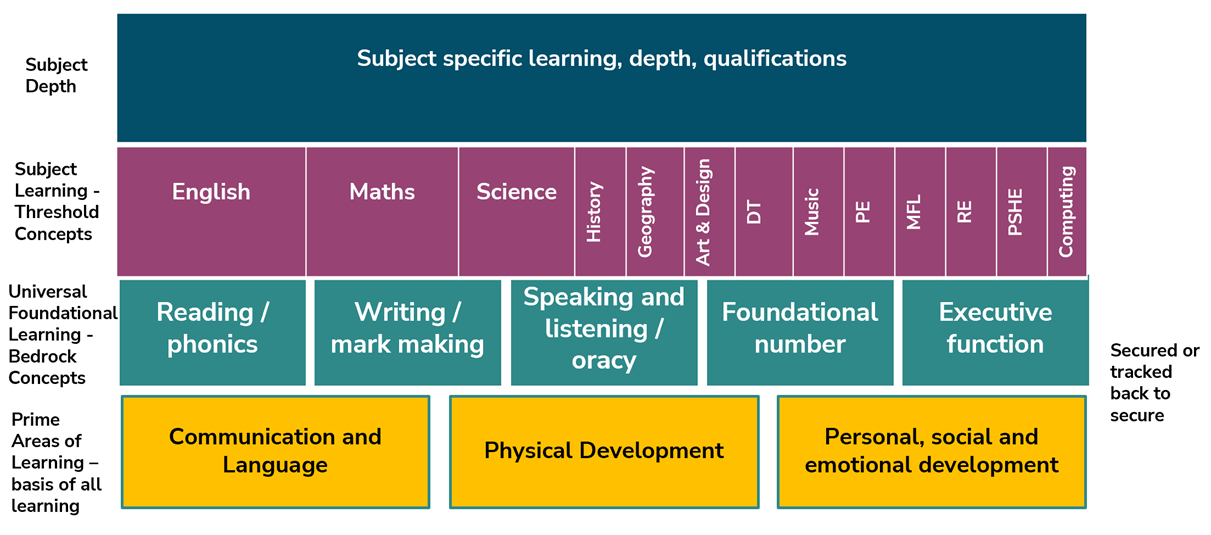
Bedrock foundational knowledge the universal cognitive and physical knowledge that must be fluent and automatic for any subject-specific learning to take place. These are not the topics we teach, but the underlying capacities – such as fine motor precision, oral language structures, and executive functions like working memory – that allow a child to engage with the world.
We often focus first on the foundational nature of reading, writing, and mathematics. While literacy and numeracy are undeniably the bedrock of the curriculum, a key takeaway from recent research (Ofsted subject reports and research reviews) is that every subject - from history to PE - possesses its own essential building blocks. We may call these ‘threshold concepts’.
If bedrock knowledge is the operating system of the brain, threshold concepts are the specific concepts that allow a child to enter a new way of thinking. For foundation subjects, think of threshold concepts as the DNA of a subject. Once a child grasps a threshold – like the logic and related vocabulary of Chronology in History or Intentionality in choosing tools and media in art – their schema undergoes a permanent change. Once secured, they act as the primary anchors for all future learning. Without this knowledge, new information has nowhere to connect, leading to fragmented knowledge that is quickly forgotten. By prioritising these threshold concepts in EYFS and KS1, we are essentially pre-wiring the child’s mind to handle the sophisticated, abstract demands of the KS2 curriculum.
How do we identify threshold concepts?
As we know, all National Curriculum subjects have their roots in learning in the EYFS[KK15.1] – this is where all subjects ‘begin.’ Each subject has specific building blocks that must be strategically sequenced within the initial layers of learning. For example, if we neglect to secure concepts such as ‘the past’, children may then struggle with more complex chronology and thinking like a historian later in the curriculum. Children who leave year one with poor pencil control may struggle later to work as an artist.
Not all knowledge carries the same structural weight; some pieces represent threshold knowledge. These are the high-leverage building blocks that act as anchors for all future learning.
As leaders, we must distinguish between the 'hinterland' (the rich, contextual stories that bring a subject to life) and the 'core' (the essential hooks that must be securely embedded in long-term memory to unlock the next level of the curriculum). So how do we know what learning to prioritise at these crucial stages? What is the foundational learning of a foundation subject? For this, I believe we need to take a wide view of the structure of a subject and examine the concepts that form its core.
While all subjects rely on a secure base of foundational knowledge, they interact with the bedrock foundational knowledge in two distinct ways. Subjects like art, DT and PE build bedrock foundational knowledge through their inherent physicality. They are the primary sites in the curriculum where a child’s physical skills such as gross and fine motor strength, hand-eye coordination, and spatial awareness are built. Conversely, subjects like history, geography, and RE provide the context for developing bedrock foundational knowledge. They offer the rich, purposeful contexts where cognitive skills like oracy, decoding, and sequencing are practiced and deepened.
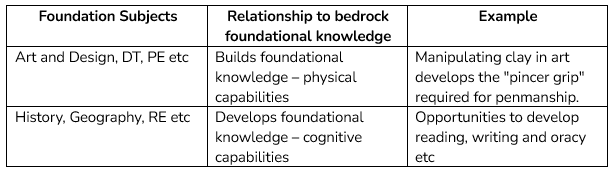
The Strong Foundations report Ofsted, 2024, emphasises that foundational knowledge consists of both substantive (the facts) and disciplinary (the skills of the expert) building blocks. The inspection toolkit now looks for "incremental" progress, meaning leaders must show that a Year 1 unit is a deliberate prerequisite for what follows and builds on key concepts from the EYFS. We can think of this as carefully sequencing the foundational bricks of a subject so that future content can be built onto an existing schema, each new concept and skill having a secure place to hook to or stick.
As I suggest in our ‘Layers of Learning’ blog series, foundation subjects can be visualised by their component concepts and threads, thus allowing us to make visible the core, fundamental concepts that underpin learning in a subject.
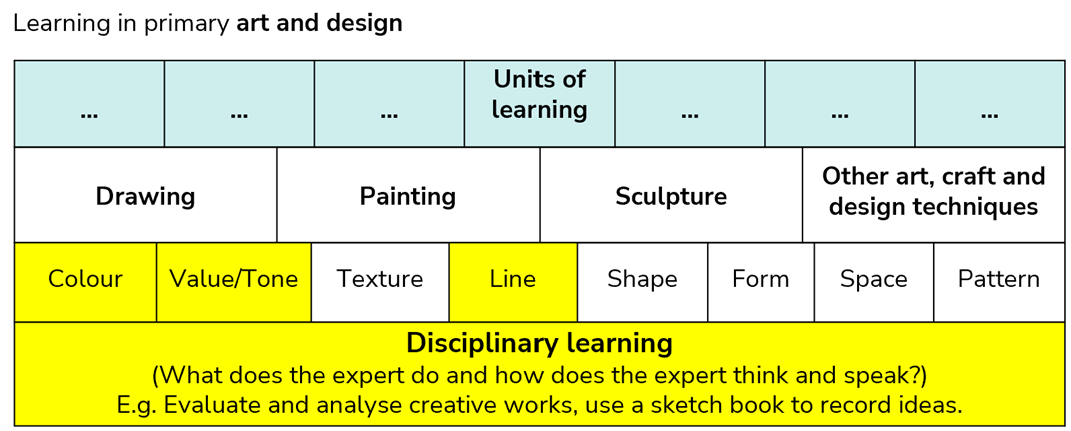
Art and design supports the further development of foundational such as fine motor control, pincer grip, visual oracy (being able to describe what they see) and executive function – which tool should I use?
As we can see from the diagram above, art and design also has threshold concepts of colour, value, line and being able to make choice about tools and media. When these threshold concepts are secure, a child’s schema has the subject-specific foundational concepts to which further subject knowledge can connect.
For example, knowing the biography of a sculptor is "nice-to-know" hinterland, whereas the ability to create different lines and select and mix primary colours is core learning: it provides a strong foundation for creating weight, movement and texture with lines or atmosphere with colours. A child who hasn't anchored the concept of primary colour mixing in KS1 will find the later task of creating atmospheric landscapes in Year 5 structurally impossible; they will lack the tools to express what they see.
Let’s look at another example of a foundation subject. Subjects like history, geography and RE offer the rich, purposeful contexts for foundational knowledge skills like oracy, decoding, and sequencing to be developed, practiced and deepened.
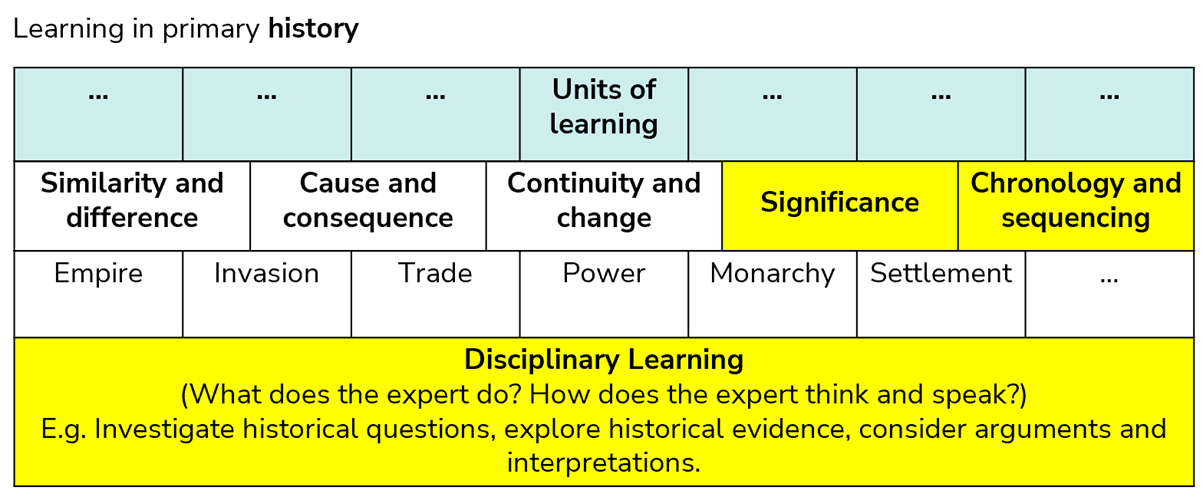
As we can see from the diagram above, chronology is one of the vital threshold concepts that forms part of the subject of history and is a key component of historical foundational knowledge during the EYFS. The focus should be on building the vocabulary and concepts necessary to grasp the "passing of time".If children don't leave EYFS with a firm grasp of chronological vocabulary and the ability to sequence simple events, they struggle to access the KS1 history curriculum. Chronology and the vocabulary related to the passing of time is therefore a threshold concept or foundational knowledge for the subject of history.
In Geography, knowing that a specific village has a red road is context, but understanding the concept of 'hot and cold places related to the equator' is the high-leverage foundational knowledge needed to understand global climate zones and biomes later. In KS1, the high-leverage disciplinary knowledge is the threshold concept of the plan view. This is the cognitive leap of imagining the world from above. In EYFS/Year 1, children create simple maps of their classroom or school grounds. If a child doesn't grasp that a map is a symbolic representation from a bird’s-eye view, they cannot access KS2 work on grid references, scale or topography.
PE is another subject that inherently builds foundational knowledge through its physicality. The foundation knowledge is core strength and Fundamental Movement Skills (FMS). These are the raw physical capacities that are developed in EYFS and early KS1. Stability (balancing), locomotion (running, hopping), and object control (gripping a ball). Without this bedrock foundational knowledge, the child’s brain is entirely focused on not falling over or simply moving their limbs. They have limited cognitive capacity to think about rules, tactics, or targets.
A threshold concept for PE would be intentional control over stability and balance, both static and dynamic. Can a child maintain a stable position while still? (e.g., standing on one leg or holding a "bird" pose). Can they maintain control while moving? (e.g., walking along a bench or a painted line). This is the foundational knowledge that allows a child to move with intention. If not secured, in Year 4 for example, a child will struggle to perform a sequence of movements. They might be able to do the "activity" of a forward roll, but they won't have the motor competence to transition into a balanced landing or an extension.
How do you identify if your subject curriculum has strong foundations?
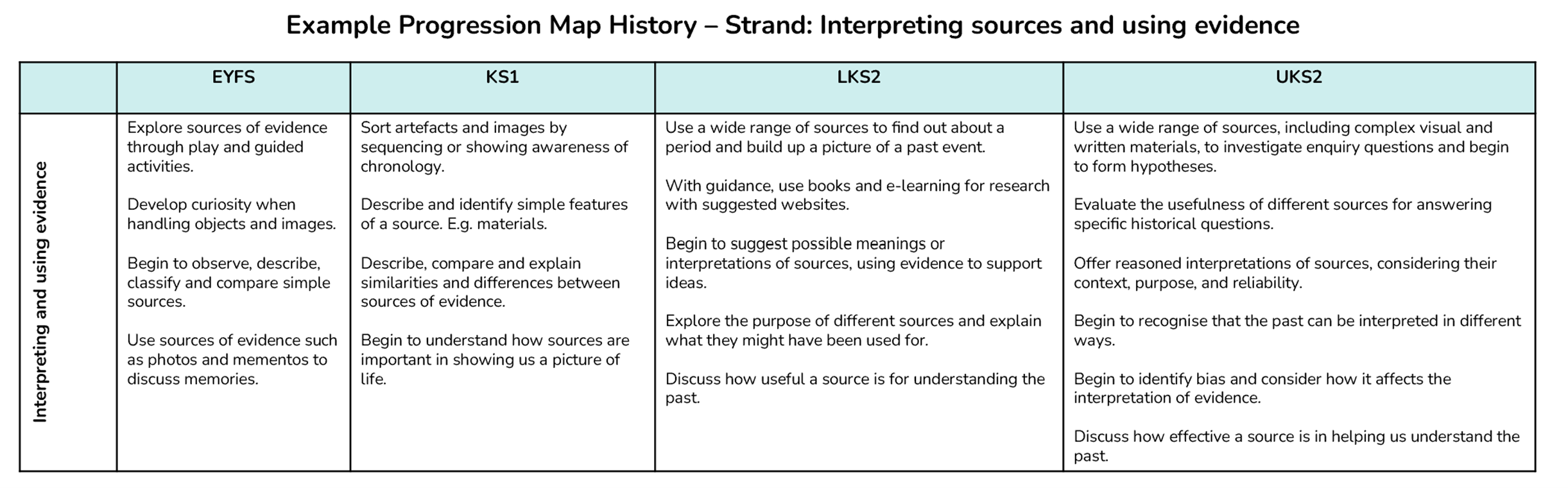
As subject leaders, we may begin by thinking about the important concepts - pillars or threads that build through our curriculum. What key concepts/knowledge does a child need in order to be successful in their learning as they progress through the curriculum? What repeats all through the scheme of work? Looking at the various strands of your curriculum and mapping out how they develop from EYFS to Year 6 will allow you to identify and prioritise the threshold concepts of foundational knowledge needed for children to reach the year 6 curriculum goals of a subject. This progression mapping also helps teachers to track back and secure gaps in knowledge that might be hindering a child’s progress. Below is an example of a history strand of using evidence mapped from EYFS to Year 6. We can see that by the end of KS1, children need to be able to describe and sequence sources of evidence. They need to know that these sources help us build a picture of what life was like. This is a disciplinary threshold concept and foundational knowledge for history; future KS2 units rely on children understanding this. We cannot teach bias or explore the possible reasons for the source being created if children do not understand this foundational knowledge.
A curriculum is not a sequence of activities, but a long-term process of schema construction. We often focus on the high-level, sophisticated outputs of the later years such as critical analysis, complex problem-solving, and creative synthesis but these functions are impossible without the stable mental models established in the early years.
By being forensic about securing foundational knowledge, particularly across Early Years and in KS1, we ensure that core concepts are moved from working memory into long-term memory. This transition toward automaticity is essential for all future learning; it reduces the cognitive load on the learner, freeing up their working memory to tackle increasingly complex and abstract challenges. When we guarantee these initial connections are robust, we provide every child with the integrated neural map they need to navigate and succeed across the entire breadth of the curriculum.
Claire Watson