In our previous blog KS2 Arithmetic 2026 – Part 1: What's Changed, What's Stayed the Same? we explored similarities and differences between this year’s paper and previous papers. In this blog, we turn our focus to the following questions: ‘Are children really taking notice of the question they are solving, or are they merely working through a process?’.
Being a successful mathematician is not just about carrying out procedures; it is about noticing structure, spotting relationships and choosing the most efficient strategy for the numbers presented. In this blog, we explore questions from this year’s arithmetic paper to consider how spotting relationships within numbers can support more efficient calculation, and what this means for our modelling and teaching.
Let’s start with some of the division calculations from early on in the 2026 arithmetic paper:
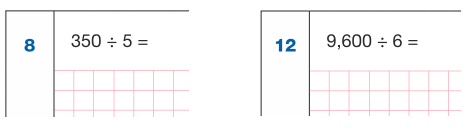
Questions 8 and 12:
Drawing attention to the base facts
Through our exploration of past papers, we have come to expect questions such as these examples. You can download your own copy of our useful summary document:
However, each year we still see many pupils defaulting to a formal division calculation whereas, I am sure that you will agree, these calculations could be significantly more manageable if we connect them to a known division fact, using our place value knowledge.
What questions and prompts could we use to lead pupils to really look at the numbers involved and linking these to base facts (or root facts) when working with multiples of 10 and 100?
Here are some suggestions for 350 ÷ 5:
- What do we know notice about 350 ÷ 5?
- 350 is ten times bigger than 35, so the quotient (or result) will be 10 times bigger:
35 ÷ 5 = 7, so 350 ÷ 5 = 70 - We could also do this as 350 = 35 tens:
35 tens ÷ 5 = 7 tens. We know 7 tens is 70.
And some suggestions for 9,600 ÷ 6:
- What do we know notice about 9,600 ÷ 6?
- 9,600 is 100 times bigger than 96, so the quotient (or result) will be 100 times bigger:
96 ÷ 6 = 16, so 9,600 ÷ 6 = 1,600 - We could also do this as 9,600 = 96 hundreds:
96 hundreds ÷ 6 = 16 hundreds. We know 16 hundreds is 1,600.
Question 14:
The power of flexibly regrouping
Question 12 links quite nicely to question 14 because we know that a number of children may try to use formal division to solve 72 ÷ 4 (and 96 ÷ 6 should they be using place value to support solving question 12).
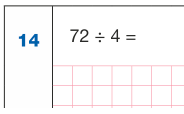
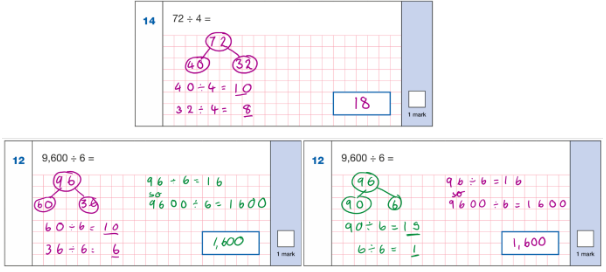
If children attempt to solve this calculation with a formal short division method, they will find that they end up splitting the 72 into 40 and 32, and therefore still need to know how many 4 in 32 when completing the second part of the formal short division. So why not use some form of regrouping without the need for the formal method?
Let’s draw pupils’ attention firstly to the divisor (the number that we are dividing by):
- Tell me some useful division and multiplication facts that you know about 4?
- What is 10 multiplied by 4?
- What is 20 multiplied by 4? How do you know?
Now let’s bring in the dividend (the number that we are dividing)
- Let’s look at the dividend: 72
- Thinking about 10 multiplied by 4 and 20 multiplied by 4, what does this tell us about 72?
- Yes! It is more than 10 groups of 4 but less than 20 groups of 4. So let’s use this information to help us to regroup into useful parts.
- 72 is how many fewer than 80? Yes, 8! What does this information tell us? (Leading to considering that 72 ÷ 4 could be calculated by subtracting 2 from 20)
From here we might look at using a part-whole model as shown in the examples below where we are choosing useful regroups to make the calculations more manageable (for question 12, two examples of useful regrouping are shown). I am using my jottings to support my thinking however continued rehearsal of this might mean that I can move away from the part whole model and perhaps just note down the calculations, or just the quotients before recombining them.
Question 11:
Giving compliments is friendly! (And finding complements is helpful)
What do you spot about the numbers used in question 11?
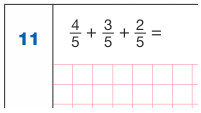
I wonder how many of our pupils will spot the complements to 1 whole in this question which arguably make this a very simple calculation (as long as we aren’t also adding the denominators together which we know can be a common misconception!). For this question, the children could use the answer as an improper fraction and so give the answer 9/5, however pupils are often encouraged to simplify their answers (which is important as discussed later in this blog for question 36). It is at the point of conversion that errors might creep in.
Perhaps your thinking might be something like mine?
- What do I notice about the numbers in this calculation?
- Well I can see that I am working with fifths and I will be adding these. All of the fractions are fifths so my denominator will be 5.
- What do I know about fifths? There are 5 fifths in a whole. I wonder if I will have more than 1 whole – I think that I will because I already know that 4 + 3 + 2 will be greater than 5, which is what we would need for a whole.
- I’ve spotted something in the numerators! I’ve spotted a complement to a whole – three fifths and 2 fifths will give me a whole! So this means that I have one whole and four fifths so my answer is 1 4/5
Questions like this illustrate why it is so important that, whenever we are modelling solving calculations, we model our ‘inner monologue’ to make the ‘thinking in our heads’ explicit.
Question 30:
Simpler but related – connecting structures
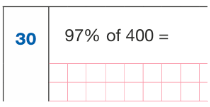
I wonder how many children here jumped straight to using a procedural method of finding 97% of 400. Perhaps they:
- found 1% and then multiplied by 97
- found 10% and multiplied by 9, found 1% and multiplied by 7
Both these methods could of course get to the answer; however they include a number of steps or working with tricky amounts, and therefore could lead to errors along the way.
Here, we could draw attention to what we know about a percentage of 100. What if we simplified this question to 97% of 100? Is this a fact that we just know? How close is 97% to the whole?
A beadstring can be a really useful representation to show 97 out of 100 as well as showing that it is 3 away from 100%:

Next we could think about scaling up.
Why scaling? If we return to the original question, we are finding a percentage of 400 which is a multiple of 100. Have pupils noticed this?
So what if we were finding 97% of 200?
- This would be 2 lots of 97.
- Or it would be 6 less than 200.
Are pupils noticing this? Are we making this relationship explicit in our modelling?

So to the original question: 97% of 400
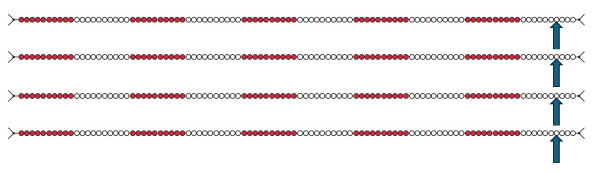
- This is 4 lots of 97 (we could use a formal written method of multiplication to solve this)
- This is also 12 less than 400 or 400 – 12 (which is arguably the simplest calculation)
Both of these approaches depend on noticing relationships rather than following a routine procedure and it could be argued that they lead to more manageable calculations.
Question 36:
An obvious procedure to follow?
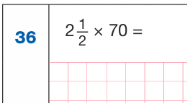
What do we teach when we are exploring multiplying an integer by a fraction or a mixed number? I have seen maths lessons and spoken to Year 5 and Year 6 pupil who are able to confidently tell me that we should convert the mixed number to an improper fraction and then we can multiply the numerator by the integer.
They are of course correct – this procedure will work.
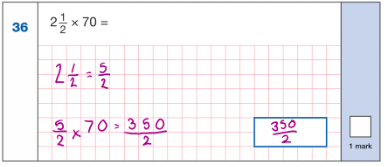
However, what pupils tend to struggle with, or fail to notice, is that the resulting fraction can be converted to an integer (a whole number), and the fact that the resulting fraction can be converted to a whole number is important, as the mark scheme demonstrates. 350 halves, or 350 ÷ 2 is equal to 175. The mark scheme is clear that to be awarded one mark, when a fraction converts to an integer, then this must be done to get the mark:

Instead of instinctively following the procedure, what might we want pupils to notice instead? Here are my thoughts:
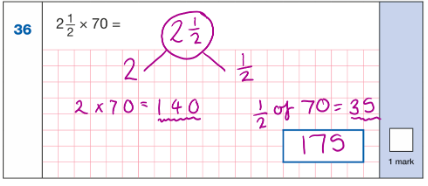
- What whole numbers are involved? 2 x 70 is a fairly nice calculation, especially if I link this with either 2 x 7 = 14 (and multiply by 10) or use my known fact of double 7 which equals 14 (and then multiply by 10).
- ½ x 70 – I know that this is the same as a half of 70 because I have previously explored the relationship between ‘of’ and ‘x’. ½ of 70 is equal to 35.
- Now I have 2 whole numbers that I can combine to 175 – easy!
I have used a part whole model to represent my thinking alongside my calculations:
Earlier this year, we wrote a blog which explored a similar question in the 2025 arithmetic paper and through the DFE’s question level analysis data published through the Analyse School Performance site, saw how this had an average success rate of 43% - the lowest of all questions in the paper. You might like to explore this further here: Diving into the 2025 KS2 SATS Arithmetic Paper: Using the Question Level Analysis
What could this mean for our teaching?
If pupils always associate arithmetic with carrying out procedures, they may overlook opportunities to use known facts, place value relationships and mathematical structures., Using these procedures can sometimes lead pupils into needing to carry out more complex calculations. Some of the most accessible solutions arise when pupils pause before calculating, look carefully at the numbers in front of them and use what they already know about the relationships between them.
Perhaps alongside rehearsing methods, we should regularly ask pupils questions such as:
- What do you notice about the numbers?
- What do you already know that might help?
- Is there a more efficient way?
- Which relationships could make this calculation easier?
These conversations, combined with the adults modelling their thinking, may help pupils develop the flexibility to select strategies appropriate to the questions that they are tackling. Perhaps success in arithmetic is not simply about whether pupils arrive at the correct answer, but whether they are noticing the mathematical structures and relationships that make those answers more accessible in the first place.
Laura Dell