If you're anything like me, the release of each year's phonics screening check prompts a slightly embarrassing level of curiosity.
Not because I'm desperately waiting to discover whether the threshold is 31, 32 or 33. (Let's be honest: most normal people have more exciting hobbies.) Rather, it's because the threshold often acts as a useful prompt to look beneath the surface and ask a more interesting question:
What is this year's phonics screening check really telling us?
This year, for the first time in the history of the phonics screening check, the expected standard dropped from its familiar 32 out of 40 to 31 out of 40.
Just one mark.
Yet, as we all know, one mark can sometimes be enough to start a thousand staffroom conversations.
Was the check harder?
Were the words trickier?
Has the balance of content changed?
Or are we perhaps looking at a remarkably familiar story wearing slightly different clothes?
As I began digging into the 2026 paper, I found myself returning to a theme I've written about before. Whether discussing disadvantaged pupils in A Tale of Two Biggies (part 2 here) or reflecting on reading fluency as literacy's "best-kept secret weapon", I seem to keep arriving in the same place: the most important stories in literacy are rarely the most obvious ones.
And, as it turns out, the 2026 phonics screening check may be another example of this.
A little phonics geekery (stay with me...)
I've spent some time looking at the composition of every check from 2012 onwards, focusing specifically on how many words draw solely on content that would traditionally be considered Reception-level learning: Phases 2, 3 and 4.
Now before anyone starts reaching for the aspirin, this matters more than it might initially appear.
After all, Phase 4 has always represented the culmination of Reception teaching. No substantial new grapheme-phoneme correspondences are introduced; instead, children are expected to apply what they already know in increasingly complex ways, particularly through adjacent consonants and more challenging word structures.
When we map the checks in this way, a fascinating pattern emerges.
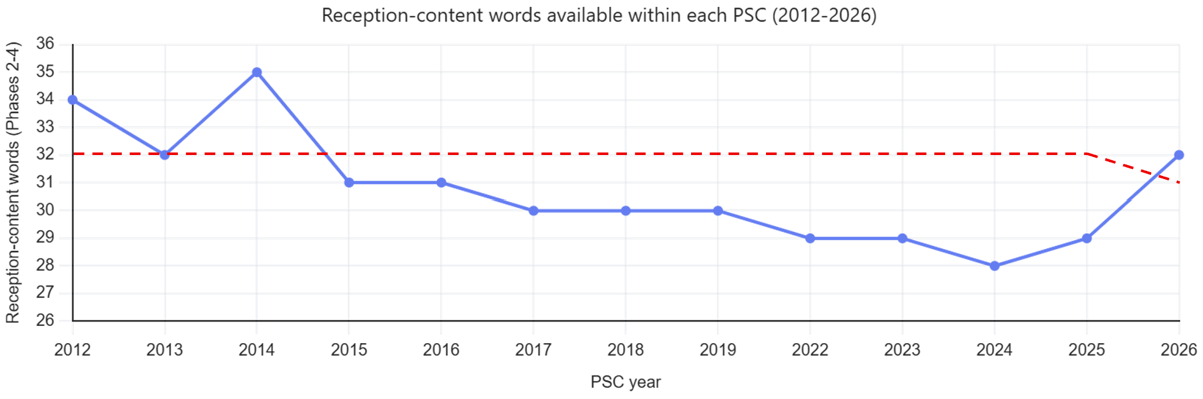
Figure 1. Reception-content words (Phases 2–4) available within each phonics screening check.
In 2026, the threshold fell to 31 for the first time, yet the paper contained 32 words rooted in Reception-level knowledge and application.
This was the finding that made me sit up and take notice.
For the first time in the history of the phonics screening check, the threshold has fallen to 31. Yet the 2026 paper contains 32 words rooted in Reception-level content. In other words, a child with secure Reception knowledge and strong application skills could theoretically access enough words to achieve the expected standard. Rather than asking whether children know enough Year 1 phonics, perhaps we should be asking a different question:
How secure, fluent and transferable has their foundational knowledge become?
After all, assessment floats on a sea of application.
It is one thing to have been taught a grapheme. It is another to recognise it effortlessly within an unfamiliar word, blend it accurately, retrieve it under pressure and apply it successfully in the moment. The screening check simply provides a snapshot of that application. The bigger picture is what happens outside the assessment hall: when children encounter thousands of words in their reading and when they begin drawing upon that same knowledge in their own writing.
Ultimately, phonics only becomes truly powerful when it moves beyond being something children know and becomes something they use.
What might that be telling us?
Now, before anyone rushes off to conclude that the check has somehow become easier, let's tread carefully.
A child still has to decode those words.
A child still has to recognise graphemes quickly and accurately.
A child still has to blend successfully, maintain attention and monitor their own decoding.
If only literacy were as straightforward as counting words on a spreadsheet.
However, the picture does raise a rather intriguing question.
If 32 of the available words are rooted in knowledge and application that should broadly be secured by the end of Reception, why do some children still find the final stretch towards the threshold so difficult?
My suspicion is that the answer lies less in what children know and more in how securely they know it.
This is where I think we sometimes risk overlooking the significance of Phase 4.
Phase 4 doesn't arrive carrying a bag full of shiny new graphemes. Instead, it quietly raises the stakes on application. Children must blend more complex structures, hold more phonemes in working memory, navigate adjacent consonants, sustain attention over longer words and maintain accuracy when the cognitive load begins to increase.
As ever, knowing and applying are not quite the same thing.
The quiet giant in the room: why Phase 4 phonics may be more important than some people think
Over the years, I've sometimes wondered whether Phase 4 gets the recognition it deserves.
Perhaps because it introduces no major new GPCs, it can occasionally feel a little less exciting than earlier or later teaching. Yet if we look closely at the screening check, Phase 4 seems to sit there year after year, quietly influencing outcomes.
Like that dependable member of staff who never asks for recognition, never puts themselves forward for awards and somehow keeps the entire show on the road.
Many children who struggle with the check do not necessarily appear to be defeated by obscure or unusual code. More often, they seem to encounter difficulties when asked to coordinate multiple elements simultaneously:
- tracking letters visually;
- retaining sounds in sequence;
- blending accurately;
- managing adjacent consonants;
- sustaining attention;
- monitoring for errors.
That is a lot of cognitive juggling for a six-year-old.
And that helps explain why the conversation cannot simply be reduced to:" Have they been taught it?"
The final few marks
In fact, looking back across the history of the check, another thought struck me.
For years, we have tended to talk about the phonics screening check as a Year 1 assessment. That's certainly true in one sense. Children sit it in Year 1 and it reflects both Reception and Year 1 learning.
Yet when we look at the composition of the papers themselves, the story appears more nuanced.
The check has never really been asking, "How far through Year 1 phonics have you raced?"
Instead, it seems to be asking something closer to:
"How securely have you embedded the foundations, and can you apply them fluently when the complexity is turned up a notch?"
That may sound like a small distinction, but I think it matters.
Because if children are routinely becoming unstuck with content that sits close to the end of Reception expectations, then perhaps we should be paying more attention to fluency, automaticity and application, rather than assuming that the answer must always be "more content".
Making knowledge stick
Readers who have followed some of my previous blogs may be noticing a recurring theme.
I promise this isn't entirely accidental.
The more I examine literacy through an inclusion lens, the more convinced I become that our most vulnerable learners are frequently fighting battles that are invisible to us.
It is not simply a question of curriculum coverage.
Nor is it merely a question of exposure.
Children can encounter a grapheme dozens of times without necessarily achieving the effortless automaticity required to apply it under pressure. That secure "whoosh" of recognition and application takes time. It takes retrieval. It takes practice. It takes successful experiences. And, perhaps most importantly, it takes meaningful opportunities to use that knowledge.
As I argued in my recent blog on reading fluency, accurate reading is only part of the story. Automaticity frees up precious cognitive capacity for everything else. Without it, children can find themselves using so much mental energy on the mechanics that little remains for monitoring, confidence or enjoyment.
The same principle may well be true more broadly across literacy.
After all, a child who has to work hard to recognise a grapheme is likely to find spelling it more difficult too. A child who has to consciously work through every phoneme in a word has fewer cognitive resources available for constructing a sentence, communicating an idea or sustaining a train of thought. Foundational knowledge remains essential, of course, but so does the extent to which that knowledge has become increasingly fluent, flexible and available for use.
Perhaps this is why some children can appear secure within a phonics lesson yet continue to struggle when faced with the demands of authentic reading and writing. Literacy in the real world asks children to do many things at once. It asks them to retrieve, apply, monitor, compose, revise and think. The more automatic the underlying knowledge becomes, the greater the capacity available for those higher-order processes.
Increasingly, I find myself wondering whether this is where some of our most important future conversations lie. Not simply in teaching the code, but in helping children become so fluent with it that they can deploy it almost without thinking. Reading fluency is part of that story; so too is transcriptional fluency. When spelling patterns, graphemes, handwriting and word construction become increasingly automatic, children are freed to focus on ideas, meaning and communication. The foundations have not become less important; they have become so well embedded that they can finally get out of the way.
Looking ahead: key lessons from the 2026 phonics screening check
So, was the 2026 check harder?
The honest answer is that I'm not sure that is the most useful question.
The more interesting question may be this:
What does the check continue to reveal about successful early literacy development?
For me, the answer feels remarkably consistent.
Strong foundations matter.
Phase 4 matters.
Fluent application matters.
Opportunities to revisit, retrieve and apply knowledge matter.
And perhaps most importantly, children need sufficient time and meaningful practice to make their learning genuinely stick.
When we view the check through that wider lens, a score of 31, 32 or 33 begins to matter a little less than the story behind it.
After all, the phonics screening check was never really about forty words.
It is about the thousands of words that come afterwards: the books children will read, the ideas they will encounter and, ultimately, the thoughts they will want to communicate for themselves. If phonics provides the foundations, our challenge is to ensure those foundations become sufficiently secure, automatic and transferable to support the rich reading and writing experiences that follow.
And that, I suspect, is a conversation worth continuing.
Our Year 1 Reading Fluency Project: Foundational Fluency provides pupils with opportunities for application to secure their knowledge and build their fluency. It launches again in January 2027. Email reading.fluency@hfleducation.org.
Kirsten Snook