One of the questions we hear most often from Year 2 teachers is: “What does reading look like once children finish the phonics programme?”
While delivering the chosen Systematic Synthetic Phonics programme (SSP), everything feels clear and structured. Children read books that match the programme exactly, assessments guide next steps, and routines are well established. It’s a smooth, predictable system – often a well-oiled machine.
But once daily phonics ends, things can feel a little less certain. Teachers often ask:
- Which books should children be reading now?
- How do I support such a wide range of attainment?
- What should my teaching focus on?
- How do I build fluency and understanding?
- How should I organise reading sessions?
These questions highlight a real gap in guidance for the ‘in‑between’ stage, after completion of the SSP, but before fully fluent, independent reading. This blog explores practical ways to build a clear, confident approach that helps children become fluent, joyful readers.
1: Creating smooth progression beyond the SSP
Most schools feel secure with their phonics scheme and decodable books, but things can get trickier once children complete the programme. A common issue is a sudden jump in text difficulty: some pupils are given chapter books they can’t yet access, while others stay with texts that are far too easy. Children require time to truly embed and apply the foundational learning from the phonics programme.
To keep progress steady, it helps to build a carefully graded bridge between phonics and fluent reading. Many schools do this by investing in a structured range of real books, including fiction, non‑fiction and poetry, organised or book‑banded to show clear progression in:
- sentence length
- vocabulary challenge
- text complexity
- the shift from early chapter books to more complex ones
This gives teachers confidence when choosing texts and helps children meet books that are both achievable and exciting. This provides a perfect recipe for reading for pleasure.
2: Assessment that makes a difference
High‑quality texts are essential, but knowing your readers is what makes the biggest difference. Diagnostic tools such as running records, fluency rubrics and dedicated time for close listening help teachers pinpoint exactly what each child needs next.
When teachers have clarity, children receive books that genuinely match their reading stage and not just their age. The result is smoother progress, better‑pitched lessons and pupils who feel ready for the next step.
3: Designing effective teacher‑led reading in Year 2
With a clear progression of texts in place, the next step is organising reading in Year 2. Because attainment varies widely and children are still developing fluency, small‑group, teacher‑led reading is the most effective structure as pupils benefit from close listening, immediate feedback and expert modelling.
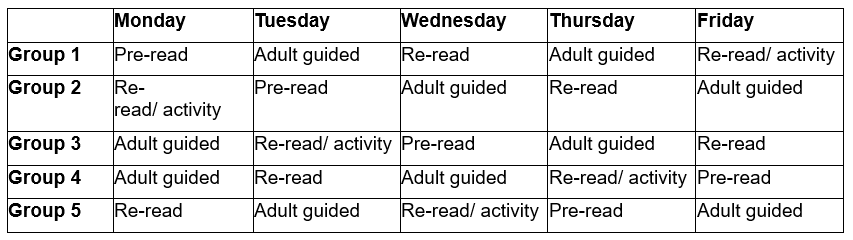
To make this work across the week, each child should experience a full reading cycle:
- pre‑reading time before meeting the teacher
- re‑reading time afterwards to build automaticity
- targeted tasks that support reading progress, such as practising GPCs, tackling multisyllabic words, spelling key words, rather than generic ‘busywork’.
This is very different from the old carousel model, where tasks often had little impact. Now, every activity has a clear purpose: to strengthen decoding, fluency and understanding.
Schools can organise this within a single class or by using adults across classes to ensure every group receives high‑quality adult‑led time.
A possible organisation across the week for teacher guided small group reading where two adults are available.
4: Using technology to strengthen independence
A simple use of technology can make pre‑reading and re‑reading far more effective. Many teachers record themselves reading each group’s book on an iPad or other device, giving children a model of expert fluency. Pupils can track the text, whisper‑read along and rehearse tricky phrasing before or after the teacher session. This works well as a pre-read.
This small tweak builds confidence, accuracy and readiness — and helps children get more from their guided time.
5: Developing reading fluency in teacher‑led sessions
Fluency is a key focus in Year 2 – a vital foundational skill on children’s reading journey - and teacher‑led sessions are the perfect place to build it. Children need regular chances to read and re-read aloud with support, practise phrasing and problem‑solve using their secure phonics knowledge.
Drawing on strategies from the Year 1 Reading Fluency Project, teachers might use:
- assisted reading
- echo reading
- brief modelling of pace and expression
A phonics‑first approach remains central: children are encouraged to decode and tackle multisyllabic words independently before the teacher steps in. This balance of modelling and child‑led problem‑solving builds confident, fluent readers who are ready for deeper comprehension.
Fluency is not an add‑on — it is the bridge between decoding and comprehension, and high‑quality teacher‑led practice ensures every child crosses it securely.
6: Deepening understanding through dialogue and shared thinking
To deepen comprehension, a dialogic approach works brilliantly in Year 2. Talk, modelling and shared meaning‑making help children move beyond recalling facts and start thinking more deeply.
Teachers and pupils explore the text together through genuine conversation, drawing on children’s background knowledge and encouraging them to model their thinking aloud. Vocabulary is explored in context, and teachers think aloud to show how skilled readers make connections and refine ideas. The Reading Framework refers to this as ‘building a mental model’.
Using Aiden Chambers’ gentle ‘Tell me about…’ prompts, instead of closed ‘Why?’ questions, creates a relaxed, collaborative dialogue that stretches children’s reasoning. Teachers then guide pupils back to the text to justify their ideas and strengthen understanding. This mix of rich talk, thoughtful modelling and purposeful questioning helps children grow into confident, reflective readers who can talk about texts with insight and growing independence.
7: Comprehension: Moving beyond answers to real understanding
Once children reach fluency, giving them a worksheet of comprehension questions often reveals only what they already know. It doesn’t necessarily deepen their thinking.
Instead, approaches such as role play, drawing and rich discussion give pupils varied, meaningful ways to show and develop their understanding. These approaches help children explore ideas, rehearse language and refine their interpretations, all with the teacher’s guidance.
8: Getting to know your children as readers
Small‑group reading is also a powerful way to truly know your readers. It’s where teachers notice:
- which books spark excitement
- how confidently children talk about what they’ve read
- how oral language supports comprehension
- reading behaviours such as glossing over multisyllabic words or missing suffixes
Spotting these patterns early means misconceptions can be addressed before they become embedded.
These sessions also create space for warm, interested conversations that help children link the text to their background knowledge and demonstrate their thinking aloud. When pupils feel listened to, supported and valued, their confidence and their love of reading grows.
When schools invest in thoughtful book progression, purposeful teacher‑led sessions and rich, meaningful talk, children feel the impact. Year 2 becomes a year where foundational reading skills are secured, readers grow in confidence, fluency and independence, not through worksheets or guesswork, but through expert modelling, well‑matched texts and genuine conversations.
Most importantly, these approaches show children that reading is valued, joyful and worth talking about. It’s in these small, daily moments that a lifelong love of reading begins.