"I write to find out what I think.” (Stephen King)
Or, put another way:
“Writing… helps pupils to consider information more deeply than when they are simply reading it; it enhances the learning of subject matter and helps cement that learning in long‑term memory. More experienced writers, for example, may find that they can resolve their thinking more effectively by actually writing than by spending time thinking about what to write.” (The Writing Framework)

What conversations do you have at school about handwriting? Teachers often have strong views: despair at children’s lack of “readiness to write”, yet also wondering, in an age of tablets, word processors and assistive technology, is handwriting even necessary? The Writing Framework is very clear: handwriting still matters. More than that, it plays a foundational role in the development of fluent, purposeful writers (and thinkers). Crucially, what it says about handwriting is not really about presentation. It’s about cognitive load, transcription fluency, writerly confidence and equity.
This blog explores what the Writing Framework tells us about handwriting, what that means for classroom practice and how HFL provide support to meet all of these aims with a clear, week‑by‑week teaching overview from Reception to Year 6, including guidance for pupils who may require adaptations.
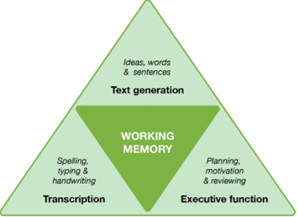
Berninger’s Simple View of Writing [1] presents three writing areas, all supported by working memory. Handwriting sits within transcription, alongside spelling (and typing). The Writing Framework is explicit: handwriting is about far more than aesthetics. It is a motor skill that, when automatised, frees up mental capacity for higher‑level decisions about meaning, structure and effect. Research tells us that handwriting speed predicts not only how much a primary‑aged child will write, but also the quality of that writing. [2] The EEF [3] summarises this clearly:
“If children have to concentrate to ensure their handwriting and spelling is accurate, they will be less able to think about the content of their writing.”
This raises the question: can handwriting also support another element of transcription- spelling? Research tells us that the physical act of handwriting helps develop pathways in the brain that link the shape of the letter to the sound it represents [4], and automatic handwriting strengthens orthographic mapping [5] - how common English spelling patterns are stored in long‑term memory, including onsets and rimes. This is a double win! By improving handwriting, we also improve spelling: two elements of transcription. However, the framework is equally clear about what not to do. Phonics and handwriting should not be combined into a single lesson. While phonics programmes introduce letters in an order that supports early reading, handwriting should be taught using letter families, grouped by similar movement patterns. These are distinct purposes and require distinct teaching sequences.
What about that nagging question- won’t these children just be typing by secondary school anyway? The Writing Framework does not reject digital tools; after all, typing is recognised as a legitimate form of transcription. However, secure handwriting and spelling are prioritised in the primary phase, to support cognitive development of all areas of writing in ways that typing does not. Technology can support writing (clearly in some cases, children’s physical needs mean that technology is the only possible method of independently transcribing), and pupils will increasingly type as they get older, but this must not come at the expense of transcription fluency.
When someone sees your handwriting, do you flush with pride or shame? Most adults will recognise the feelings attached to their handwriting- sadly for me embarrassment and offering an explanation that my writing needs to be an attainable goal for pupils! The Writing Framework highlights that pupils who experience persistent difficulty with transcription are more likely to avoid writing, write less or label themselves as “not good at English”. Pupils who struggle to form letters legibly or at speed often receive more negative feedback and are less positively perceived by their audience, including teachers and assessors. In contrast, when handwriting is secure, pupils are more likely to see themselves as writers and to approach writing with confidence and pleasure. In terms of the Simple View of Writing, automatic transcription frees up motivation to write.
What statutory guidance says about handwriting (and what it doesn’t)
When schools discuss handwriting policy, it is often assumed that the National Curriculum [6] and EYFS Statutory Framework [7] provide detailed direction. In reality, statutory handwriting guidance is non‑prescriptive and outcome‑focused.
By the end of Reception children are expected to write recognisable letters, most of which are correctly formed, write simple phrases and sentences that can be read by others, and hold a pencil effectively. By the end of Key Stage 1, pupils should write legibly, and on leaving primary school, they should use legible joined handwriting, when writing at speed.
The revised National Curriculum is due to be published in Spring 2027. The Writing Framework suggests it is sensible for schools to focus now on securing high‑quality transcription teaching while awaiting publication of the updated documents, bearing in mind the foundational skills focus of the Curriculum and Assessment Review [8] and Ofsted’s toolkit and operating guides [9].
Strong foundations in reception
Research shows that explicit teaching, monitoring and feedback on letter formation are vital for developing speed and fluency [10]. The Writing Framework is clear that this work should begin from term one of Reception. At this stage, the focus is on quality rather than quantity. Key elements include:
- developing gross motor skills for core strength, balance and spatial awareness
- strengthening fine motor control and precision
- explicitly teaching and modelling effective pencil grip and posture
- beginning to learn letter formation
- daily handwriting lessons
- using pencil and paper rather than whiteboards
- sitting at a table when writing (but not distracting children from incidental, volitional writing by moving them to a table!)
Top tips for classroom practice in the primary phase
Whole‑school approach
- Teach handwriting regularly, explicitly, precisely and cumulatively.
- Plan a clearly sequenced progression, with built‑in opportunities for review.
- Agree on one handwriting font and style of joins and ensure this is modelled consistently by all staff.
- Keep handwriting expectations consistent across the school, in all year groups and subjects.
- Notice, value and celebrate progress so pupils understand that handwriting matters.
Discrete and timetabled teaching
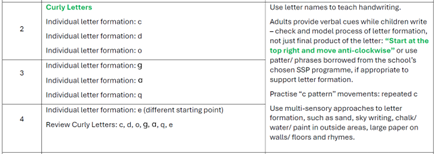
- Timetable handwriting explicitly and teach it little and often.
- Teach handwriting discretely, rather than relying purely on practice through other writing tasks.
- Teach letters through letter families and shared movement patterns, not phonics letter sequences, to secure motor memory.
Explicit instruction and modelling
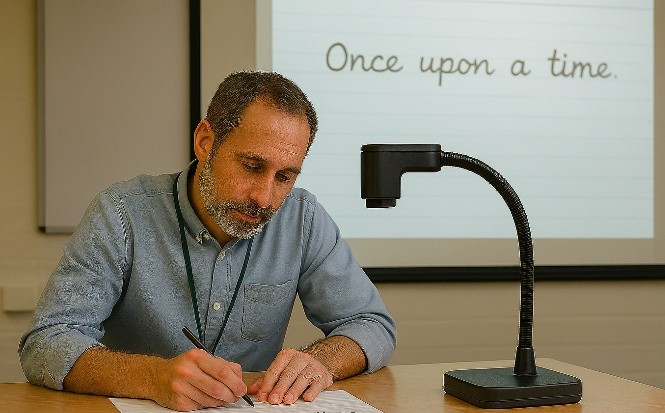
- Model letter formation and joins clearly, using verbalised movement patterns to support pupils’ understanding (using a visualiser is great for this).
- Avoid relying on tracing, copying or unsupervised practice, as this can reinforce incorrect motor patterns.
- Only expect lead‑in strokes if this is a deliberate and agreed whole‑school approach.
Practice that builds automaticity
- Ensure secure, accurate letter formation before introducing joins or increasing speed.
- Prioritise legibility, consistency and fluency.
- Monitor writing speed to help identify underlying difficulties.
- Observe pupils closely during handwriting and give live, targeted feedback to address misconceptions immediately.
What if they need more support?
The Writing Framework emphasises the importance keeping up, rather than catching up, through quality first teaching. But it also recognises that progress will not be uniform. Some pupils will need additional, targeted support to prevent difficulties becoming embedded.
Before intervention, stop and analyse: are difficulties rooted in discomfort, limited motor control, hand–eye coordination or fatigue? Close observation of the process of writing- not just the finished product- is essential. What can they already do and what are their next steps? A clear progression will allow you to track back to identify targets.
Although the Writing Framework emphasises supporting children within the whole-class handwriting lesson, for some pupils, including those with developmental coordination disorder (DCD, sometimes known as dyspraxia), structured handwriting interventions may be necessary. Where transcription remains a significant barrier to learning, technology can play an important role- but it should sit alongside, not instead of, handwriting instruction. Multi‑sensory strategies (for example air writing, large‑scale movements, tactile resources) may support pupils with additional handwriting needs.
Assistive alternatives should be used thoughtfully, once difficulties have been identified and specifically supported. Adaptations should always maintain high expectations while enabling success.
What if you need more support?
The Writing Framework’s message is clear: when handwriting is taught well, it fades into the background- allowing ideas, language and structure to take centre stage. For research-based guidance, The National Handwriting Association [11] offers up-to-date support for schools.
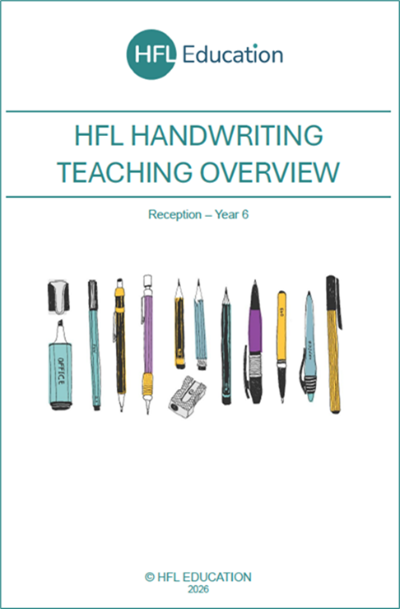
If you would like to strengthen handwriting provision in your school, our Handwriting Teaching Overview (Reception–Year 6) offers a fully sequenced, cumulative progression with weekly teaching foci, built‑in review and clear guidance for adaptation and intervention. It aligns with the National Curriculum, the Writing Framework, the Ofsted toolkit and operating guides and guidance from The National Handwriting Association.
The Handwriting Teaching Overview is available with PA Plus or as a one-off purchase- email primaryenglish@hfleducation.org for more information. As always, we’ll be here to support you with any implementation needs, including training. Let’s enjoy helping our children to express themselves freely and have their voices heard!
References and further reading
[1] Berninger, V.W., Amtmann, D. (2003). Preventing written expression disabilities through early and continuing assessment and intervention for handwriting and/or spelling problems: Research into practice. In Handbook of Learning Disabilities, Swanson, H.L., Harris, K.R., and Graham, S. (Eds.) (pp. 345 – 363). New York: Guilford Press
[2] Hurschler Lichtsteiner S, Wicki W, Falmann P. Impact of handwriting training on fluency, spelling and text quality among third graders. Read Writ. 2018;31(6):1295-1318. doi: 10.1007/s11145-018-9825-x. Epub 2018 Jan 29. PMID: 29875546; PMCID: PMC5966469. https://pubmed.ncbi.nlm.nih.gov/29875546/
[3] Education Endowment Foundation (2021) ‘Improving Literacy in Key Stage 1’ https://educationendowmentfoundation.org.uk/education-evidence/guidance-reports/literacy-ks-1
[4] https://www.sciencedaily.com/releases/2011/01/110119095458.htm
[5] Marano G, Kotzalidis GD, Lisci FM, Anesini MB, Rossi S, Barbonetti S, Cangini A, Ronsisvalle A, Artuso L, Falsini C, Caso R, Mandracchia G, Brisi C, Traversi G, Mazza O, Pola R, Sani G, Mercuri EM, Gaetani E, Mazza M. The Neuroscience Behind Writing: Handwriting vs. Typing-Who Wins the Battle? Life (Basel). 2025 Feb 22;15(3):345. doi: 10.3390/life15030345. PMID: 40141690; PMCID: PMC11943480. https://www.mdpi.com/2075-1729/15/3/345
[6] National Curriculum https://www.gov.uk/government/publications/national-curriculum-in-england-english-programmes-of-study/national-curriculum-in-england-english-programmes-of-study
[7] EYFS Statutory Framework https://www.gov.uk/government/publications/early-years-foundation-stage-framework--2
[8] Curriculum and Assessment Review Final Report (2025)
https://www.gov.uk/government/publications/curriculum-and-assessment-review-final-report
[9] Ofsted Education Inspection Framework 2025 https://www.gov.uk/government/publications/education-inspection-framework
School inspection: toolkit, operating guides and information - GOV.UK
[10] Prunty MM, Barnett AL, Wilmut K, Plumb MS. An examination of writing pauses in the handwriting of children with developmental coordination disorder. Res Dev Disabil. 2014 Nov;35(11):2894-905. doi: 10.1016/j.ridd.2014.07.033. Epub 2014 Aug 7. PMID: 25105570. https://pubmed.ncbi.nlm.nih.gov/25105570/
[11] National Handwriting Association https://nha-handwriting.org.uk/