How data can transform reading progress in secondary schools
Secondary schools in the UK often pride themselves on being ‘reading data rich’. Every year, we collect countless test scores, reports, and assessments. Yet too often, we remain insight poor when it comes to understanding the real barriers that prevent students from making progress in reading.
The principles ought to be simple:
- Know each student’s reading profile and competencies.
- Identify those who need extra help and target reading support precisely.
- Monitor progress consistently so no one’s reading skills fall behind.
When these systems are in place, schools can offer a strong, universal reading offer for all students, alongside carefully designed targeted support and interventions where needed most.
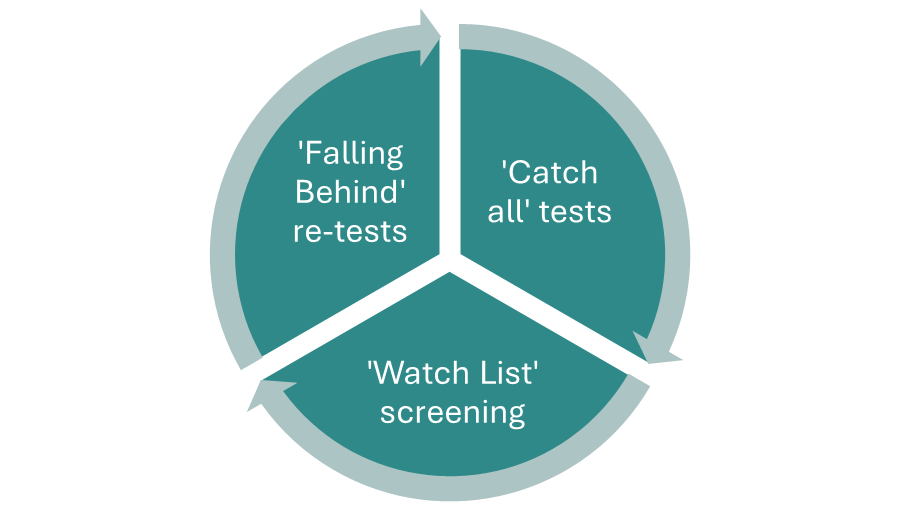
A Simple Cycle for Reading Assessment
Strategic leadership of reading doesn’t have to be complicated:
- ‘Catch-All’ Testing (Universal Assessment)
This is your baseline: the testing you do with all students. From this, you generate your ‘watch list’ of students with potential reading struggles. This early flagging triangulates with prior assessment data and ensures no student slips through the net. - ‘Watch List’ Screening (Targeted Assessment)
From the ‘watch list’, more detailed diagnostic screening takes place. These assessments help distinguish between fluency issues, phonics gaps, or other barriers such as SEND needs. The point is not just to spot a difficulty, but to name it, so targeted intervention can follow. - ‘Falling Behind’ Re-testing
Secondary schools—especially in Years 8, 9, and 10—are full of students who work really hard to mask their reading challenges. Grades might start dropping, behaviour points rise, and/or attendance slips. These signs often point to underlying reading struggles. Re-testing helps identify these students before they are lost to disengagement. From this set of data, we can tailor precise interventions to help students keep up not just catch up.
At every stage, the tests used must be fit for purpose. They should reveal not just whether a child is underachieving, but why. Is the issue phonics, fluency, motivation, or even undiagnosed SEND? The answers then guide interventions, CPD priorities, and classroom adaptations.
A cycle of ‘Catch All’, ‘Watch list’ and ‘Re-testing’ leads to exacting interventions:
The HFL Reading Fluency Project offers a model of how schools can use data for insight, not just information. Schools begin by scrutinising their ‘catch all’ test data to produce a longlist of students, then refine this into a ‘watch list’ for targeted diagnostic testing (e.g. the GL YARC assessment). Subsequent reading barrier diagnoses then ‘action’ the deployment of specific, time limited and impactful reading support.
This recent case study by Scott Davies, Executive Director of English at WeST, and Rebecca Cosgrave, Primary English Advisor, Devon Education Services, shows how carefully chosen systems of assessment can transform huge swathes of student outcomes. Where assessment data diagnoses dysfluency (or directs to other needs such as phonics or SEND), the subsequent delivery of the HFL Reading Fluency Project has empowered participating teachers in fluency instruction and there is ‘strong, quantitative data coming in that is really powerful’.
HFL Reading Fluency Project average reading comprehension progress:
- KS4: +2 years 8 months
- KS3: +1 year 8 months
- KS2: +2 years 3 months
- KS1: +1 year 6 months
These are average comprehension improvement scores after the twice weekly 8-week intervention (based on the GL YARC tests). And, the gains don’t stop at data. Students also show improved confidence, enjoyment, and attitudes towards reading—a transformation that reverberates across the curriculum.
Secondary schools can move beyond being “data rich and insight poor”. By reframing assessment as a tool for understanding barriers—not just measuring outcomes—we put ourselves in a position to intervene effectively and meaningfully. The reading data collected can then also provide a lens for how reading is taught universally in all lessons as well as the targeted choices based on ‘watch list’ students. If schools can achieve these two things, many more students are more likely to seek out all those wonderful ‘reading for pleasure’ enrichment opportunities without even realising it.
Students’ futures are shaped not only by how well we track their data, but by how insightfully we act upon it. Strategic cycles of testing, diagnosis, and intervention give us the tools to ensure that every young person leaves school not just “getting by” in reading but truly equipped to thrive.
Join us for our next Reading Fluency Project to ensure fluency is part of your ‘Reading Leadership strategy’.
If you’re keen to explore how the reading fluency project could have impact across your Trust or setting before committing to the full project, get in touch via reading.fluency@hfleducation.org.
A Simple Cycle for Reading Assessment: