Behind every powerful piece of writing lies two essential building blocks: vocabulary and grammar. These components aren’t just technical details, they’re the tools that allow young writers to express ideas with clarity, precision, and creativity. In this latest instalment of our series of blogs exploring the Writing Framework, we will delve into the topic of vocabulary and grammar and how they are fundamental to breathing life into writing.
Vocabulary and grammar can both be found within ‘Section 4: Composition’ of the framework, pages 47-73. For more reflections on this section more broadly, do take a look at this previous blog written by Rickella.
Vocabulary
The writing framework references the National Curriculum which states:
“Effective composition…requires…an increasingly wide knowledge of vocabulary”
We know that children with a breadth of vocabulary at their fingertips are likely to be more proficient in communicating their intended message and effect for the reader. We want to empower curiosity in young writers to explore new vocabulary through rich reading and high-quality models for writing.
In order to do this successfully, the framework discusses the importance of explicit vocabulary instruction and references the work of Beck, McKeown and Kucan in exploring the tiering of vocabulary. Tier 2 vocabulary is the sweet spot for vocabulary instruction – exploring this rich, literary language which children are going to meet time and time again in quality literature. These transferable words often appear across a range of writing and can provide the depth and breadth of vocabulary needed to improve the quality of writing. Spending time teaching and discussing the effect and impact of these language choices can enable children to experiment with them in their own writing.
The Writing Framework references the following strategies to support in the teaching of vocabulary effectively:
- providing pupil-friendly explanations of the meaning of the word in the context in which it is encountered
- enabling pupils to encounter the words in different ways e.g. in a sentence linked to their experiences; in talk and in writing; analysing both literal and abstract meanings
- analysing the word’s morphology and etymology
- using visuals to help in defining vocabulary, with the use of physical objects
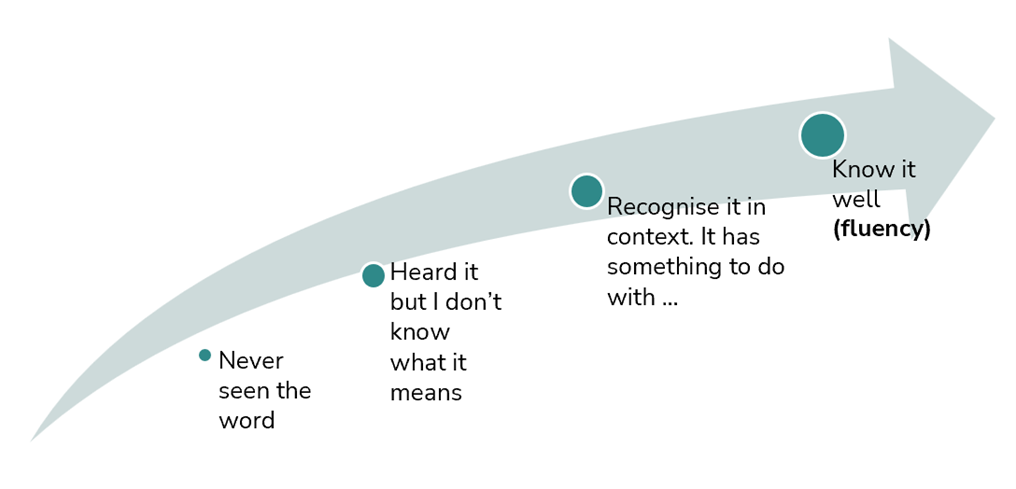
When introducing tier 2 vocabulary, it is crucial to plan opportunities for children to revisit these words repeatedly, as rich word knowledge develops through multiple encounters. This requires deliberate curriculum design, where such opportunities are mapped out to allow children to explore vocabulary in varied contexts. Although children often have a general sense of what these words mean, they need explicit teaching to use them confidently and accurately. Through these intentional encounters, children’s understanding evolves into broader concepts rather than words remaining as standalone terms.
Grammar
Let’s now draw our attention to the grammar section from the Writing Framework, the messages of which are reflected in the recently published Curriculum and Assessment Review final report.
The framework states that:
“…grammar teaching will improve writing only if pupils apply what they have been taught to their writing. Grammar instruction is most effective when taught in the context of a writing task…so that pupils can make informed choices about their writing.”
This is a welcome message. Rather than teaching grammar in isolation, the framework emphasises contextual learning. This means linking grammar instruction to authentic writing experiences. Pupils need to see how choices in sentence structure, word choice and punctuation affect tone, clarity and style. For example, instead of rehearsing pupils on sentence types, show them how authors use short, sharp sentences for impact or longer, complex ones to build tension.
Teaching children to rehearse and recite definitions of grammatical features is often too abstract a concept. Without examples, rooted in high quality literature, children do not have something concrete on which to hang these abstract concepts onto. Model texts become essential here - they demonstrate grammar in action and help pupils see the effect on meaning.
When teaching grammar, children should be evaluating the work of authors, considering how the grammar choices they have made have influenced our experience as readers. We then want to provide opportunities for children to experiment with these techniques, reasoning how they impact the purpose and effect in their own writing.
Most importantly, grammar should never overshadow creativity. It’s not about perfection; it’s about giving pupils the tools to express themselves effectively. When grammar is taught as part of purposeful writing, it becomes empowering rather than intimidating.
The Curriculum and Assessment Review final report concludes that:
“…a thorough knowledge and understanding of grammar is crucial to success, not just in English but across all subjects. We therefore recommend that the grammatical content… should include a stronger focus on using and applying grammar rather than on identifying theoretical constructs by name, which is not developmentally appropriate or meaningful.”
We await how these recommendations will affect change in the National Curriculum English Programmes of Study over the coming months. The review panel has recently been announced, and you can read more about who will be shaping the curriculum here: The experts shaping England's new curriculum | Tes.
In summary, both grammar and vocabulary should support composition, not overshadow it. A key takeaway is to ensure that grammar and vocabulary teaching are integrated into meaningful writing opportunities and not taught in isolation. We can support children in making choices linked to grammar and vocabulary according to their intended audience and purpose for writing thus linking their composition to writerly choices for the reader. By helping pupils understand how words and structures shape meaning, we empower them to make deliberate choices in their own compositions.
If you wish to find out more on how to enhance writing provision in your school and integrate grammar and vocabulary teaching through the writing process, do take a look at our award-winning writing curriculum: ESSENTIALWRITING. This ambitious and progressive writing programme from Early Years to Year 6 is fully aligned with the key messages in the Writing Framework.
References:
Beck, I. L., McKeown, M. G. and Kucan, L. (2013) Bringing Words to Life: Robust vocabulary instruction. New York: Guilford Press.
DfE Writing Framework (2025)
DfE Curriculum and Assessment Review Final Report: Building a world-class curriculum for all (2025)