As a new academic year begins, one investment worth making early is working with children to construct sentences before their pencil touches the page. Sentence construction activities can provide a powerful foundation for primary writing. By giving children opportunities to rehearse, construct and combine sentences orally before they write, teachers can help pupils develop sentence structure, build confidence and reduce the cognitive demands of writing. This blog explores why lesson time devoted to sentence construction activities may be one of the most effective ways to strengthen writing foundations, build confidence and support all writers from day one.
Why sentence construction matters in primary writing
Learning to write is one of the most cognitively demanding tasks that children undertake at primary school. Even a simple sentence requires a child to balance multiple processes simultaneously: generating ideas, selecting vocabulary, ordering words, applying spelling patterns, considering punctuation and physically controlling a pen or pencil to form letters. The Writing Framework reminds us that these competing demands place a significant burden on working memory for all writers and particularly for children whose handwriting and spelling are not yet automatic. (The writing framework pages 19-23)
When working memory becomes overloaded, it becomes harder to give equal attention to every process. The demands of transcription (handwriting and spelling) can reduce the cognitive resources available for sentence construction and composition. This can result in writing that is shorter, less detailed or less sophisticated than the ideas a child can express verbally. It may also explain why some children find it tricky to consistently apply the sentence structures that they have been taught, despite demonstrating an understanding of them during class discussions.
How oral sentence rehearsal supports primary writers
So how can oral sentence rehearsal and sentence combining help all children when writing?
Imagine a class are preparing to write a story about a dog. Before any writing begins, the teacher shares an image of a dog and invites children to discuss what they think is happening.

Before reading on, have a go yourself. How many different sentences can you create from this simple starting point?
Here are some sentences that children may have orally rehearsed linked to different year group programmes of study:
Reception:
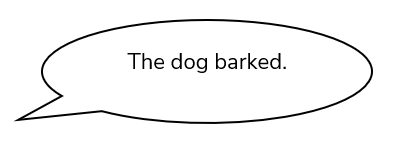
EYFS Framework statement: articulating ideas and structuring them in speech, before writing.
Year 1: The dog barked and showed its teeth.
National curriculum statement: Joining words and joining clauses using ‘and’.
Year 2: The dog barked because it heard a noise.
National curriculum statement: Learn how to use subordination ‘because’
Year 3/4: The dog barked loudly because it could hear somebody outside.
National curriculum statement: Using conjunctions, adverbs and prepositions to express time and cause
Year 5/6: The dog, which was usually quiet, barked loudly.
National curriculum statement: Using relative clauses beginning with who, which, where, when, whose, that, or an omitted relative pronoun.
In just a few minutes, children will have orally generated, refined and evaluated a range of sentence possibilities. By the time writing begins, much of the compositional thinking has already taken place which frees children to focus more fully on the demands of transcription.
Sentence construction activities: Sentence combining
Sentence combining, where children orally join, expand, rearrange or modify sentences before writing them, is another highly effective way to support children with this process. Through exploring and comparing alternative sentence constructions, children explore how grammar shapes meaning and learn to make deliberate choices as writers.
One way to scaffold discussion is by using simple physical resources. Children might manipulate prepared sentence fragments (cut up sentences) to explore different possibilities and the effect created by each choice. For example, matching sentence fragments together:

Whilst both sentences meet part of the Year 2 objective of joining clauses using subordination, they do not communicate the same meaning. By reading the sentences aloud and discussing them, children might discuss character behaviour, cause and effect and the images created for the reader. They can then select the conjunction and sentence structure that best communicates their intended meaning.
Activities like these can be shared and repeated for children in all year groups and with any sentence structure focus. When children are used to this process, they will also begin to apply these steps when writing independently to overcome their own barriers at the point of composition or when editing their work. In this blog from our archives, further sentence construction activities are explored which also support pupils’ sense of a sentence.
In writing lessons, it can be tempting to move quickly from discussion to writing. The goal is not to replace writing with talk, but to use purposeful talk to strengthen the writing that follows. By establishing routines such as oral rehearsal and sentence combining early in the academic year, teachers can help children develop a deeper understanding of sentence structure and greater confidence as writers. As a result, the writing they produce will provide evidence of their thoughtful discussions, deliberate decision-making and purposeful choices as writers.
For further guidance on how to support pupils to understand and craft sentences, please see the Writing Framework section 4: Composition.
For more examples of sentence combining activities, please see Appendix D of the Writing Framework.
For more fun and effective activities to teach sentence structure, please take a look at our Securing Full Stops at KS1 or our Fixing Full Stops Across KS2 training.
Heather Ford