It is that time of year again when we look back at the 2026 KS2 SATs reading paper. In this blog, we will explore key takeaways, reflect on what we can learn from this year's assessment and consider how these insights could support teachers as they begin to think about pupils’ readiness for 2027.
In 2026, children were presented with 3 texts and faced 38 questions, totalling 50 marks. The texts increased in complexity and word count as the children progressed through the reading booklet, which could have posed a stamina challenge for pupils whose reading fluency needed further development.
The extracts
1. Owl in Danger. A fictional narrative extract telling the story of two friends, Mandy and James, and their discovery of a baby tawny owl. (565 words; 16 marks)
2. Matilda’s Invention. A fictional narrative extract about a character called Matilda, a lover of science with ambitions to be an inventor. (629 words; 16 marks)
3. Amelia Earhart. A non-fiction biography exploring the life of the pioneering female aviator. (767 words; 18 marks)
How the domains were tested
Content domains | |||||||
2a | 2b | 2c | 2d | 2e | 2f | 2g | 2h |
| Give/ explain the meaning of words in context | Retrieve and record information | Summarise main ideas | Make inferences/explain and justify inferences | Predict what might happen next | Identify/explain narrative content as a whole | Identify/ explain how meaning is enhanced through word or phrase choice | Make comparisons within a text |
10% | 36% | 4% | 42% | 0% | 4% | 4% | 0% |
Here we can see that the 2026 paper has followed the pattern of previous years with the largest proportion of questions being tested under the domains of vocabulary, retrieval, and inference.
Whilst analysing the proportion of marks for each test domain can help us to draw conclusions and elicit trends, we must also exercise caution here. Fundamentally, knowing your cohort of children, their strengths, and their areas for development in reading is going to be much more useful for you in planning the next steps to support their reading moving forward.
As referenced in the DfE reading framework, we need to be mindful not to solely use these test domains as a framework for teaching reading but instead prioritise helping our children build a holistic mental model of reading.
“… the domains as a whole should not be used as a framework for teaching reading. Organising the teaching of reading around those domains… will restrict pupils’ access to the wider national curriculum and is likely to inhibit their enjoyment of reading.”
The Reading Framework, DfE, 2023.
The Goal of Inference
In 2026, almost half of the reading paper tested the inference domain. This is not entirely surprising given how vital inference is to the teaching (and enjoyment) of reading. However, it is likely to be useful for us to pause and reflect on what we really mean by this. We might begin by revisiting our conceptual model for the teaching of reading.
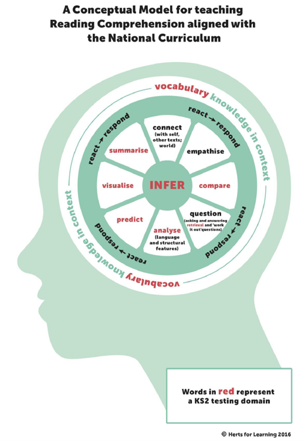
In this diagram, inference sits at the heart of the model, drawing on and connecting several processes involved in reading. Expert readers use a range of reading skills simultaneously to construct deeper meaning from a text. By the end of Key Stage 2, we want pupils to be able to confidently integrate these different reading skills, mentally weaving them together to make thoughtful and well-supported inferences.
You may wish to consider: If inference sits at the heart of effective reading comprehension, are we teaching it as an isolated ‘skill’ or are we helping pupils bring together all the knowledge and processes that underpin successful inference?
Considering the complexity of the questions
Although the questions within the answer booklet will have been assigned to one of the test domains, many of the questions in the reading paper will also rely on children employing other reading processes in order to give an accurate response. Let us look at a couple of examples.
The inference domain first appears in question four of the test and is worth two marks if answered correctly.
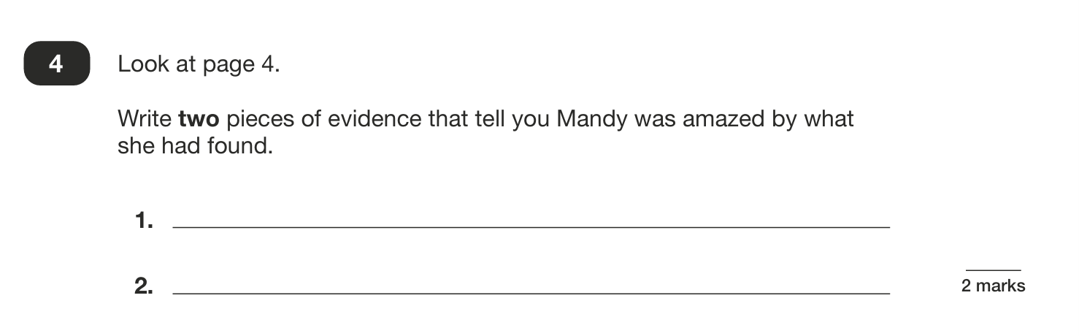
In this example, the children will have needed to make connections to the behaviours demonstrated by the character in the story to recognise that they were ‘amazed’ as referenced in the question. Examples cited in the mark scheme included: Mandy drawing her breath and her eyes shining.
Visualisation could have supported children here as they pictured what the character was doing (show not tell). Alongside these skills, children will also have had to integrate the language to successfully interpret the phrase ‘Mandy drew in her breath…’. The use of the verb ‘drew’ here could have posed an additional challenge to pupils who may have taken this more literally or who were unfamiliar with the verb ‘drew’ to mean taking a breath in. Although this is an inference-domain question, when we dig a little deeper, we can see that it requires several reading processes for success.
If we now look at question 38, the final question on the paper that would earn the pupil three marks if answered correctly. I wonder how many of the children managed to get to this question in the time provided and, if so, had time to collect the evidence required to secure the marks. These three marks could be the difference between children reaching or missing that all-important scaled score of 100.
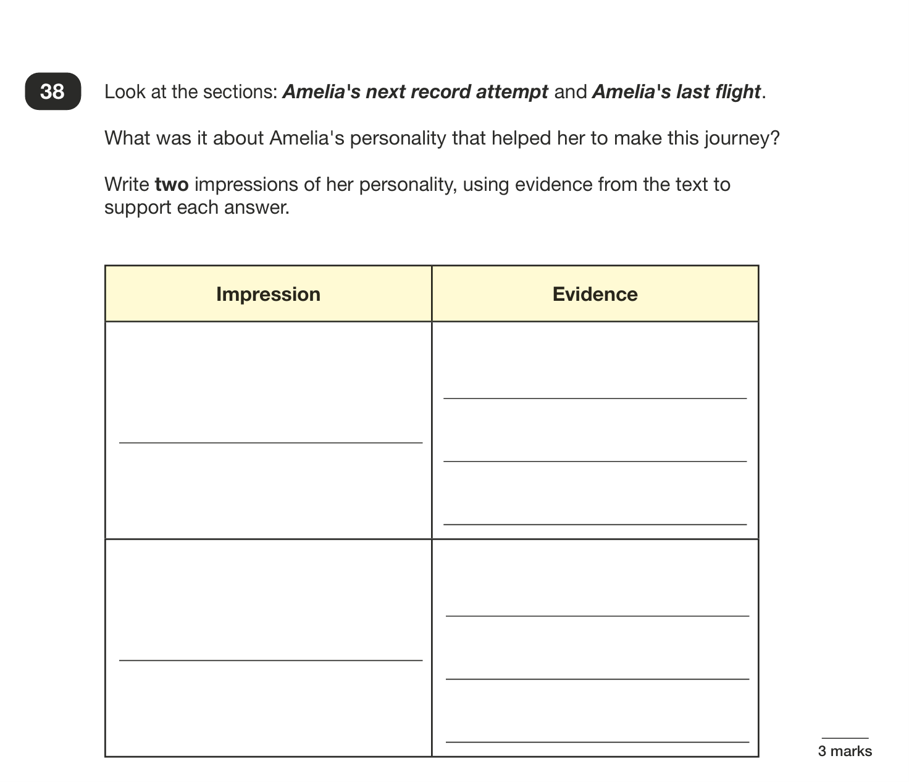
As referenced previously, reading stamina is most likely to be at play here. The mark scheme requires the children to provide two distinct impressions, with at least one exemplified with evidence.
The children will have needed to re-read the sections of the text and summarise in their minds the achievements of Amelia Earhart to draw conclusions that she was both determined and brave (as referenced in the mark scheme). They would then have needed to find evidence to prove their thinking. Interrogating vocabulary within the question may also have created a challenge here. Could the children successfully relate the words ‘impression’ and ‘personality’ to uncover what they were being asked to do?
These highlighted questions again demonstrate the importance of children not seeing reading skills in isolation. Through high-quality discussion and reasoning within reading lessons, children can be prompted to draw upon a repertoire of skills when answering questions.
Vocabulary
Vocabulary is an integral element of reading instruction and subsequently reading success, so there is no surprise that there were words present in this year’s paper which could have posed a challenge.
If we take a look at the final text from the paper, Amelia Earhart, the children faced a high density of tier 2 words as well as several tier 3 words which would have needed interpreting.
Tier 2 | Literary language which will appear repeatedly in high-quality literature. | pioneering; voyage; determined; strong-willed; unconventional; promote; reputation; established; honour; outspoken; extraordinary; assist; investigation; rumour; enduring |
Tier 3 | Domain- or content-specific vocabulary. | aeroplane; continents; aviation; pilot; altitude; aviator; globe; equator; capacity; refuel; kilometres; coastline; navigator |
More information about the tiering of vocabulary can be found in Bringing Words to Life: Robust Vocabulary Instruction by Beck, McKeown and Kucan.
Equipping children with a range of vocabulary attack strategies is key to ensuring that they have a bank of tools at their disposal to break down meanings of unknown or unfamiliar words.
Supporting children to make connections to vocabulary can be a great strategy to link words with similar underlying meanings.
Let us take a look at the tier 3 words ‘aviation’ and ‘aviator’, which carry a large weight of meaning in this text. I wonder if children could make connections to the words ‘avian’ or ‘aviary,’ linking them to birds and flight. They could then apply some knowledge of morphology here. The suffix ‘-ion’ is used to make a verb into a noun and describes the ‘act/action of’ something. The suffix ‘-or’ links to a person or a thing that performs an action e.g. director, educator or doctor.
Aviat-ion – noun – the act of flight
Aviat-or – noun – a person who flies
You may find this previous blog useful in unpicking some more approaches to explicitly teaching vocabulary: Improving vocabulary for primary pupils.
What about poetry?
It is worth noting that poetry has yet to reappear in the KS2 SATs since 2018, but it is vital that children are still provided with plenty of opportunities to read these fantastic texts. Poetry is a wonderful vehicle for children to practise authentic read-alouds, explore structure and rhythms and delve into the richness of language. For more inspiration about the teaching of poetry, do visit this previous blog which offers some further thoughts on how to ignite poetry exploration in your classroom: Raising the profile of poetry.
Final thoughts
It is important to remember that we do not want the Year 6 SATs to be the driver for the decisions we make regarding the teaching of reading; SATs can sit happily in the passenger seat.
Fundamentally, if we ensure that our children receive a rich diet of reading throughout the school day and benefit from nourishing discussions within reading lessons, the test will largely take care of itself. Let us prioritise creating a generation of young people who love reading, love to be inquisitive about reading and love to talk about reading.
For more CPD on supporting children towards year 6 success, you may be interested in our full package of Year 6 tailored training:
Success in Year 6: writing and moderation | 27 January 2027
Success in Year 6 maths | Starting 13 October 2026