Climate change and sustainability are becoming increasingly prominent within discussions about the primary curriculum. For many teachers, this feels both important and daunting. Where should this learning sit? How much scientific understanding do young children need? How can schools be honest without frightening pupils or implying that children are responsible for solving problems created by adults?
A useful starting point is to stop treating sustainability as a separate topic. Environmental education already connects meaningfully with learning across the curriculum. Geography explores weather and climate, rivers, settlements, land use, resources, food, trade and contrasting places. Science develops knowledge of materials, living things, habitats and seasonal change. Design and technology considers materials, purpose, users and evaluation. History helps pupils understand how relationships with landscapes, resources and technology have changed.
The opportunity is not to add a collection of climate activities. It is to identify where sustainability genuinely strengthens subject learning, then sequence those encounters so that pupils’ knowledge grows in depth and complexity.
What does the Curriculum and Assessment Review suggest?
The Final Report of the Curriculum and Assessment Review, published in November 2025, identified climate change and sustainability as an applied area of knowledge needing strong attention. Rather than proposing a new standalone subject, it recommended earlier and more coherent learning within established subjects, stronger content in geography and science, clearer attention within design and technology, and sustainability within a core primary citizenship entitlement.
This direction matters. Climate education should not become everybody’s responsibility but nobody’s disciplinary learning. Different subjects contribute different knowledge and different ways of thinking. Schools should begin with their existing curriculum: where are the authentic connections, where are the gaps, and where would an additional sustainability link become forced or overload learning?
Geography: connecting knowledge, enquiry and place
Geography offers a natural home for bringing strands of climate education together because it examines relationships between people, places and environments. However, meaningful geographical learning goes beyond establishing that climate change is happening or producing a list of actions children might take. Pupils need knowledge of how physical and human processes interact, how places are connected, how resources are used and distributed, how environments change, and why decisions affect people differently.
Enquiry and fieldwork help children apply this knowledge. Pupils can formulate questions, gather and record evidence, identify patterns, draw conclusions and evaluate findings. The enquiry question provides the purpose. An energy audit, traffic count or litter survey is not automatically meaningful fieldwork. It becomes meaningful when it helps pupils answer a worthwhile question, connect evidence with prior learning and reach a geographical conclusion.
Building a rich schema
Understanding does not develop through one assembly, themed week or environmental project. It grows through carefully planned encounters that revisit important ideas in different contexts. Concepts such as place, environment, weather, climate, resources, interdependence, change and sustainability can recur throughout the primary journey.
A child who notices seasonal change in EYFS may later collect weather data in KS1, investigate microclimates or water movement in lower KS2, and analyse evidence relating to climate patterns and sustainability in upper KS2. Each encounter reactivates and extends what came before. Progress is not simply more facts. It is a richer, better-connected schema that enables pupils to recognise patterns, compare places and form increasingly informed judgements.
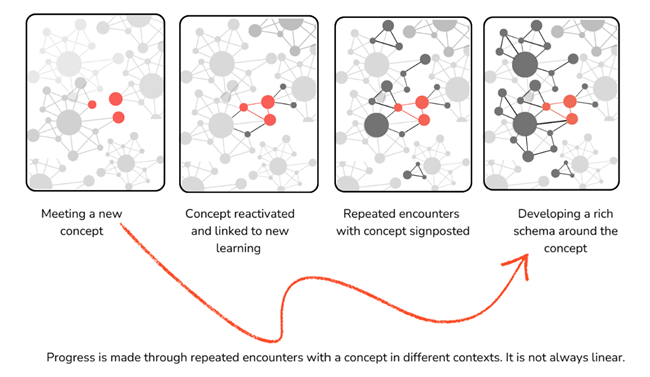
This does not mean every school needs a new sustainability progression map. Schools may find mapping useful, but it is a curriculum design choice, not an end in itself. The more important task is to check that key ideas are introduced, revisited and deepened rather than appearing as isolated experiences.
From caring to informed action
Children are often motivated to learn because they care. A connection with a place, a local environment, a species or a community can spark curiosity and create a desire to know more. Yet caring alone is not enough. If pupils are to move beyond slogans and assumptions, they also need knowledge, evidence and understanding. Care can open the door to learning; carefully sequenced learning then equips children to make informed judgements and take meaningful action.
A useful progression might move from noticing, connecting and becoming curious; observing change, exploring relationships, investigating impact; considering alternatives and making informed decisions. Children should experience familiar environments and normal patterns before being expected to understand threats or disruption. This is not a rigid framework. It illustrates how learning can develop from concrete, local experience towards more complex geographical thinking.
Caring is important, but education's role is to transform care into understanding. Understanding then enables informed action.
EYFS: noticing, exploring and caring
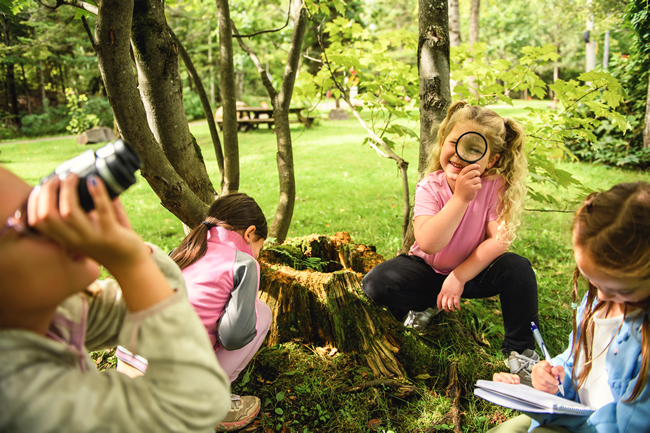
Begin with firsthand experience of place, weather, seasons, living things, change, needs and care. Children might revisit a tree, explore soil and water, notice where plants grow, or discuss how an outdoor space is used. They can talk, draw, photograph, sort and compare. Questions such as "How has our tree changed?" establish foundations without introducing an abstract global crisis. The emphasis is connection and manageable, collective agency.
KS1: recognising patterns and simple human impact
Children can explore visible local issues such as litter, shade, traffic, noise, water use and green space. They might ask where a new tree or bin should go, how weather changes through the year, or how people travel to school. Simple maps, photographs, tallies and observations support conclusions.
At this stage, children's care for their environment can be channelled into geographical enquiry. The shift is from "litter is bad" to an evidence-based question such as "We found more litter near the gate. Why might this be?" or "What does this show us about how people use this space?" Children begin to see that improving places requires understanding them first.
Lower KS2: exploring systems and interdependence
As knowledge of settlements, rivers, climate, food, trade and resources grows, pupils can investigate how parts of systems connect. Enquiries might explore where rainwater goes, which surfaces absorb most water, where food comes from, or how school grounds could support more living things.
Pupils can use infiltration tests, surveys, counts, measurements, questionnaires, sketches and simple graphs. As they identify patterns and connect data with maps and locations, they begin to appreciate that environmental issues rarely exist in isolation. Caring is increasingly supported by understanding how people, places and environments depend upon one another.
Upper KS2: evaluating evidence and possible futures
Older pupils can encounter more explicit climate-change learning when it builds on secure knowledge of climate, biomes, settlements, energy, resources and physical processes. They might investigate how sustainable the school is, how grounds could respond to hotter summers or heavier rainfall, where solar panels might be located, or how transport affects the local area.
Progress is not simply about using more complicated equipment. It is about increasingly sophisticated reasoning. Pupils ask:
- What does the evidence show?
- Whose perspective is represented?
- Who benefits?
- Who may be disadvantaged?
- Is this proposal sustainable over time?
- What evidence is still missing?
Pupils should also encounter examples of mitigation and adaptation, including how communities, scientists, engineers, planners and governments respond to environmental challenges. Their care for people and places remains important, but it is now supported by knowledge, evidence and critical thinking. Rather than being encouraged to act first, pupils learn how informed decisions emerge from a secure understanding of complex issues.
Keeping each subject distinctive
Cross-curricular learning is strongest when each subject retains its disciplinary integrity. History can examine changing land use, energy, transport, sanitation and consumption while attending to historical context. Design and technology can explore material choices, durability, repairability, product life cycles and designs for changing conditions.
Art can deepen observation of places and seasonal change while still developing artistic knowledge and technique. Computing can support data collection, digital mapping and evaluation of online information. Citizenship can explore shared responsibility, democratic participation, fairness and competing viewpoints. RE can examine stewardship, responsibility and the ways religious and non-religious worldviews shape environmental choices, without directing pupils towards a predetermined response.
Avoiding climate anxiety
Careful curriculum design can help schools remain truthful, hopeful and age appropriate:
- Begin with the observable before introducing abstract global systems.
- Build explanatory knowledge so that vague threat is replaced by structured understanding.
- Match complexity to age and prior learning.
- Avoid individual blame by placing personal choices alongside infrastructure, government, business and technology.
- Include response and adaptation, not only environmental problems.
- Let meaningful action arise from learning, perhaps through sharing fieldwork evidence or proposing a realistic improvement.
- Make room for uncertainty, alternatives, trade-offs and questions.
Five practical starting points for schools
- Audit, do not simply add. Identify where sustainability already strengthens subject learning.
- Choose a small number of recurring concepts, such as place, change, interdependence, resources and decision-making.
- Strengthen one local enquiry by beginning with a worthwhile question and requiring an evidence-based conclusion.
- Check the sequence so pupils meet familiar environments and normal patterns before threats and possible solutions.
- Review the message. Remove tokenistic tasks, individual blame and alarming content that is not matched to pupils’ knowledge.
Final thoughts
Sustainability education need not become a collection of themed days, alarming facts or disconnected activities. Nor should geography become the place where every environmental concern is deposited. Schools can identify a small number of ideas that recur and deepen, first through immediate surroundings, then through local and contrasting places, and eventually through more complex systems and global connections.
Fieldwork gives the learning authenticity. Children do not merely hear that environments change; they observe change. They do not jump immediately from problem to campaign; they gather evidence, analyse, compare, conclude and consider alternatives.
Perhaps this is geography’s most important contribution: helping children move from caring about the world to wanting to understand it, and from having an opinion to forming an informed geographical judgement. Our aim is not to raise anxious children burdened by global challenges, but informed pupils who are curious about the world and increasingly confident in their ability to understand it. When children care, they often want to learn more. When knowledge deepens that care, they are better placed to make thoughtful decisions and take action that is purposeful, realistic and informed.
For more advice, guidance and inspiration regarding weaving eco-literacy into your curriculum, why not book onto our Big Staff Meeting ‘Sustainability through the curriculum’ on 1st December?
Claire Watson