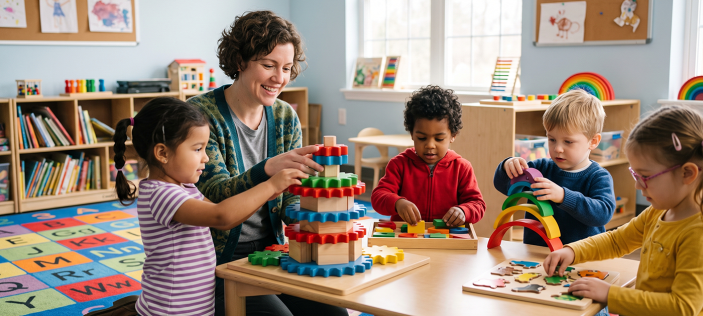
Early years settings across Hertfordshire are becoming increasingly rich in linguistic diversity. Children arrive at settings and school with a wide range of languages, experiences and cultural identities, and it is our responsibility to ensure these are not only recognised but genuinely celebrated.
Children learning English as an additional language are developing English alongside the knowledge, skills and understanding they have already acquired through their home language or languages and their wider experiences. When we recognise and value every language a child uses, we move beyond inclusion and begin to create a true sense of belonging.
Understanding the challenges
Starting at a setting or school can be a significant transition for any child. For children who are developing spoken English, whether they are new to the language or continuing to build fluency, there can be additional challenges as they navigate a new environment, routines, relationships and language.
Practitioners may find it more difficult to gain an accurate picture of children’s knowledge, skills and understanding when children are not yet familiar with English. Communication with families may also require additional consideration, and staff can feel uncertain about how best to support the development of English alongside children’s home languages. These challenges should not define a child. By recognising and building on the linguistic, cultural and personal strengths children bring, practitioners can create an environment in which every child feels valued, included and a genuine sense of belonging.
Practical strategies to support multilingual learners
Creating a welcoming and language-rich environment does not require practitioners to speak every language represented within their setting. Small, thoughtful adaptations to everyday practice can have a significant impact on children's confidence, communication, and sense of belonging.
- Visual representation: Visual supports can help children understand routines, communicate basic needs, and develop independence. Their effectiveness increases when children actively use images to communicate requests, emotions, and choices. Pairing visuals with spoken language, first in the child's home language, where possible, and then in English, can support language acquisition across both languages. Personalised visual timetables shared between home and the setting can also strengthen children's understanding of daily routines and provide reassurance during transitions.
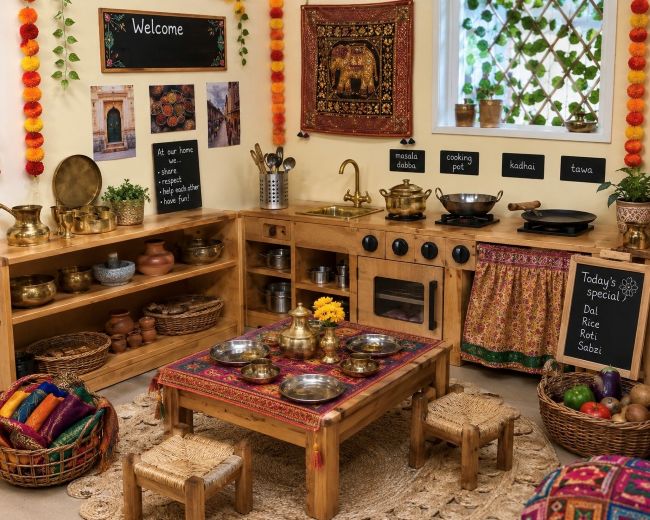
- Authentic resources: Moving beyond tokenistic resources is essential. Familiar household items, cooking utensils, fabrics, books, and artefacts from children's home cultures should form part of everyday provision rather than appearing only during special celebrations. Reflect on your role-play and home corner areas. Do they authentically represent the children and families in your setting? Do they reflect the diversity of your current cohort and staff team? Authentic representation helps children see themselves, their families and their experiences reflected in the environment every day.
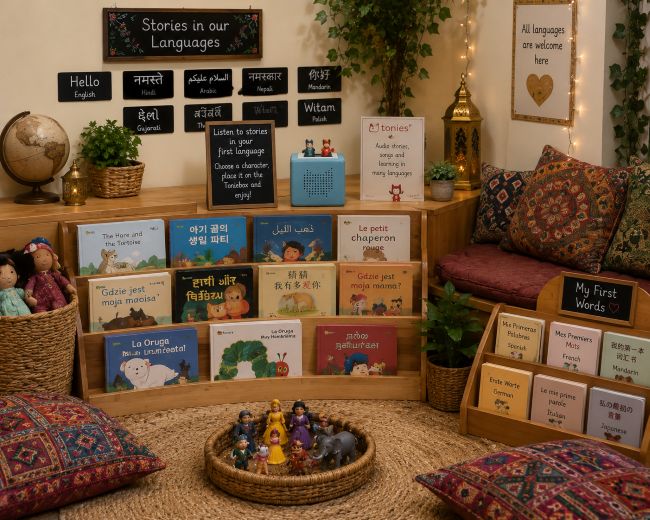
- A language-rich environment: A consistent and predictable environment helps children feel secure and confident. Books in home languages and bilingual texts can be enhanced through the use of audio recordings, storytelling by multilingual staff and contributions from families. Resources such as recording devices can provide opportunities for children to hear stories in their first language throughout the day. Story sacks or story support boxes containing props, figures, and key vocabulary cards in both English and the child's first language can further increase engagement and understanding.
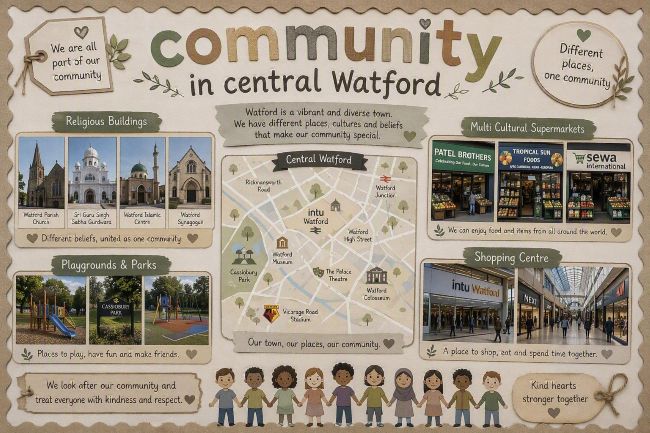
Community boards displaying local places, family photographs and familiar landmarks can help children make meaningful connections between their home and setting experiences, strengthening their sense of belonging. Music also provides powerful opportunities to celebrate different languages and cultures. Sharing songs from children's homes and communities’ helps build connections, creates shared experiences and reinforces the message that all languages are valued.
Targeted teaching and evidence-informed support
Practitioners do not need to be fluent in a child's home language to provide meaningful language support. What matters most is creating an environment where children feel valued, understood, and confident to communicate.
There are many simple yet highly effective strategies that can be woven into everyday practice:
- learning and using key words such as greetings, comfort words and phrases linked to children's everyday needs
- providing additional processing and response time during conversations and group interactions
- using repetition, modelling and sustained shared thinking to extend language and understanding
- encouraging children to use their home language during play, recognising that strong first-language development supports the acquisition of additional languages
- planning opportunities for bilingual and multilingual children to develop and extend both languages, celebrating multilingualism as a strength
- using activities such as chatter boxes, which contain familiar objects, photographs, and meaningful items from children's lives, to stimulate conversation and support communication skills.
Alongside high-quality everyday practice, settings may also benefit from evidence-informed interventions and professional development programmes to strengthen communication and language provision. These approaches can provide valuable guidance, assessment tools, and practitioner training to support children learning EAL.
Sources of further support include:
- The Bell Foundation
- Elklan
- Every Child a Talker (ECAT)
- WellComm
- HFL Education's Terrific Talkers programme
By combining intentional teaching strategies with evidence-informed approaches, practitioners can create language-rich environments that value multilingualism, support communication development and strengthen children's sense of belonging.
Leadership considerations
Creating an inclusive environment for multilingual children requires a whole-setting approach. Strong leadership plays a key role in ensuring that effective EAL practice is embedded throughout the setting and reflected in everyday interactions.
Leaders may wish to consider:
- developing an EAL policy that outlines the setting's values, approaches, and procedures for supporting multilingual children and their families
- including supporting EAL learners as a focus within supervision, appraisal discussions, and professional development opportunities
- auditing the environment to ensure it authentically reflects children's lives, cultures, and languages
- considering how bilingual staff can be utilised to strengthen relationships with children and families
- reviewing whether resources, teaching approaches and visual supports are meeting the needs of the current cohort.
Creating a culture where multilingualism is recognised as a strength helps practitioners feel confident in their role and ensures that all children have the opportunity to thrive.
Avoiding unconscious bias and tokenism
While cultural celebrations and themed events can be valuable, belonging is not achieved through occasional activities alone. Children should see their languages, cultures and experiences represented consistently throughout the year and across all areas of provision. True inclusion happens when diversity becomes part of the everyday experience rather than something that is only acknowledged during specific celebrations.
This means:
- embedding languages and cultures throughout everyday play, routines, and learning experiences
- ensuring books, resources and displays reflect the children who attend the setting
- being curious, respectful, and open to learning from children and their families
- challenging assumptions and reflecting on our own unconscious biases.
When children regularly see themselves and their families reflected in the environment, they are more likely to develop a strong sense of identity, confidence and belonging.
What does the research say?
The Department for Education's (DfE) guidance for early years providers emphasises the importance of continuing to support children's home languages while they learn English. Rather than viewing home languages as a barrier, they should be recognised as valuable strengths that contribute to children's learning and development.
Further information can be found in the DfE: English as an additional language
Working in partnership with parents
Parents and carers are experts in their children's language, culture, and experiences. Developing strong partnerships with families is therefore essential when supporting children who are learning English.
There are many ways settings can work collaboratively with parents, including:
- gathering information about children's languages, interests, and experiences through "All About Me" documents
- inviting families to share key words, phrases, songs, and stories from home
- encouraging parents to record stories or songs in their home language that can be accessed within the setting
- using family photographs to support conversations, displays and community boards
- seeking parents' views and experiences to ensure provision reflects the needs of the current cohort.
When families feel welcomed, respected, and involved, children are more likely to develop confidence across both home and setting environments.
Conclusion
Multilingualism is an asset. When children’s languages, cultures and experiences are reflected in everyday practice, they feel seen, heard and valued. This strengthens belonging and supports children to thrive, communicate confidently and develop a positive sense of self. Ongoing professional development can help practitioners deepen their understanding of language acquisition, culturally responsive practice and effective support for multilingual learners.