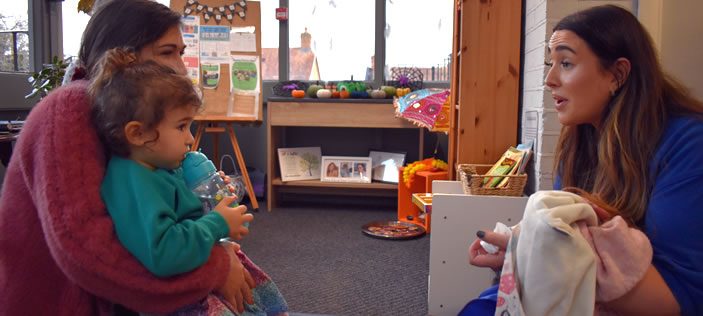
Children’s sleep has long been recognised as a vital aspect of healthy development, with children under the age of two requiring between 12 and 16 hours of sleep within a 24‑hour period. Those working with young children will be familiar with the significant impact that a lack of restful sleep can have on a child’s wellbeing, learning and ability to fully engage with the provision. This understanding reinforces the importance of offering appropriate opportunities for children to rest and sleep during the day. However, sleep is also a vulnerable time for young children. Considering recent high‑profile and deeply concerning cases linked to unsafe sleep practices in early years settings, the Early Years Foundation Stage is set to be updated to provide clearer guidance and strengthened requirements to ensure children can sleep safely while in our care.

Time for a change
Following the tragic deaths of Genevieve ‘GiGi’ Meehan and Noah Sibanda who both lost their lives in early years settings due to unsafe sleep practices; the sector welcomes clear guidance on safer sleep in settings for babies and young children.
Ahead of changes to the Early Years Foundation Stage Statutory Framework in September 2026, the Department for Education have published clear guidance for early years staff around how to create a safer sleep environment in settings.
The very vulnerable
Some key changes include a focus on the vulnerability of very young babies who are at a higher risk of SIDS (Sudden Infant Death Syndrome).
All children aged 12 months and under must be put to sleep in a cot, which includes Moses baskets and travel cots, with settings being asked to check whether products meet British Safety Standards. Babies under the age of 6 months must have an adult with them in the same room for every sleep and sleep comforters can only be used for babies and children aged 12 months or over, except for dummies. Cots must not contain any items such as toys, pillows, loose bedding, bumpers, wedges or straps and the temperature of the room for those 12 months and under is recommended to be 16-20C.
Children must be placed down to sleep on their back. Once babies can move from their back to their front and back again by themselves, they can find their own sleep positions but must still be placed to sleep on their back, in their own sleep spaces on a clear, flat, firm surface.
Blankets must be used with caution. When in use, they must be firmly tucked in around the child, no higher than their shoulders, with the baby placed ‘feet to foot’ at the bottom of the cot. A child’s head should never be covered. A well fitted sleep bag offers an alternative, but manufacturers recommendations must be checked before use.

Supervising sleep
As noted above, all babies under the age of 6 months must always have an adult with them in the same room, for every sleep. All children must be checked regularly, these checks should be thorough, and include a review of a child’s sleep position, breathing, the position of the blanket or comforter and monitoring whether a child is too hot or cold by feeling their chest or the back of their neck. Children who get too hot are at a higher risk of SIDS and therefore if a child feels clammy or sweaty, bedding or layers of clothing must be removed.
All children must be withing sight and hearing of staff at all times. For those children over the age of 6 months, this can be facilitated with a baby monitor, however it must allow all children to be seen and heard.
Travel and sleep
The update makes it clear that babies must be transferred to their cot once they return to the setting if they have fallen asleep whilst travelling. In addition, extra clothing such as hats or outdoor wear should be removed as soon as they go indoors, even if this wakes the baby.
Additionally, children over the age of 12 months who fall asleep whilst travelling should be transferred to their own separate sleep space once they return to the setting. It is now clear that a pram or pushchair, even those with lie-flat capabilities should not be used as a main sleep space.
What next?
To prepare for the 2026 Statutory updates, leaders should urgently complete the following actions:
- Read the Department for Education guidance and share with all staff.
- Check whether your sleep products meet the British Safety Standards, outlined in the DfE guidance.
- Create a sleep policy that outlines your specific procedures around sleep and how these follow safer sleeping guidance.
- Ensure all staff understand safer sleep procedures – add this to your induction and supervision processes.
- Share your sleep policy and any further updates with parents, ensuring they are clear on the safer sleep procedures from the very beginning.
- Consider how supervision of sleep may impact staff deployment and plan for this. For example, ensuring there are enough staff available so that children under the age of 6 months always have an adult with them when sleeping.
- Remove any items that do not meet the British Safety Standards and/or do not promote safer sleep.
- Hertfordshire PVI settings can contact their District Early Years Consultant for further support and advice.
- Update all staff knowledge of Sudden Infant Death Syndrome (SIDS).
- Check The Lullaby Trust website for further information and resources.
Useful further reading:
Department for Education – safer sleep publication:
www.help-for-early-years-providers.education.gov.uk/health-and-wellbeing/safer-sleep
Information on SIDS:
www.nhs.uk/baby/caring-for-a-newborn/sudden-infant-death-syndrome-sids
The Lullaby Trust:
www.lullabytrust.org.uk/baby-safety/safer-sleep-information
Read more about the Campaign for GiGi here:
www.lullabytrust.org.uk/about-us/our-campaigns/campaign-for-gigi
Jo Watkins